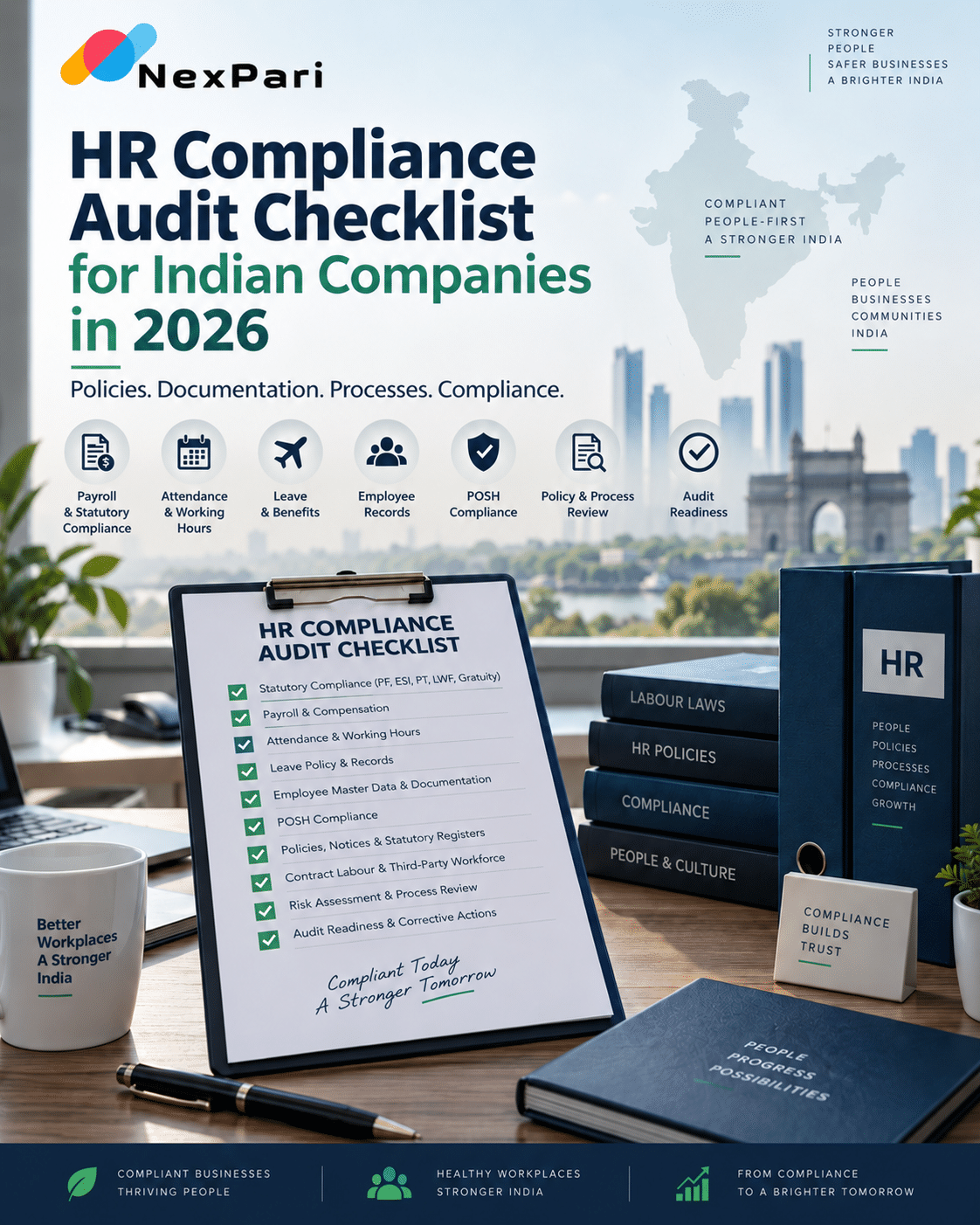
An HR compliance audit helps a business understand whether its HR policies, employee documentation and day-to-day people processes are structured, current and consistently followed.
For companies searching for an HR compliance checklist in India, the most important principle is simple:
Compliance should not become a once-a-year documentation activity.
It should be integrated into the way employees are recruited, onboarded, managed, paid and separated.
India’s four Labour Codes came into force on 21 November 2025. Government information highlights minimum wages, timely wage payments, social security, appointment letters and safe working conditions among key elements of the framework.
For startups, SMEs and growing companies, this makes regular HR process reviews increasingly valuable.
What Is an HR Compliance Audit?
An HR compliance audit is a structured assessment of:
- HR policies
- Employee documentation
- Employment processes
- Payroll procedures
- Attendance
- Leave
- Workplace mechanisms
- Employee records
- Performance processes
- Grievance handling
- Separation processes
- Applicable statutory practices
The audit should examine both:
What your HR documents say
and
What your organization actually does.
A company can have an impressive employee handbook and still face operational gaps if managers follow completely different processes.
Why Should Companies Conduct an HR Compliance Audit?
An HR audit can help organizations identify:
- Missing documentation
- Outdated policies
- Inconsistent practices
- Weak approval mechanisms
- Undefined responsibilities
- Employee communication gaps
- Compliance risks
- Process inefficiencies
It is particularly useful when an organization is:
- Hiring rapidly
- Expanding to multiple locations
- Formalizing HR
- Preparing for due diligence
- Creating new policies
- Restructuring departments
- Increasing employee headcount
- Replacing informal HR practices
20-Point HR Compliance Audit Checklist
1. Review Appointment Letters
Check whether employees receive appropriate employment documentation.
Review:
- Job title
- Department
- Reporting
- Compensation
- Work location
- Relevant employment terms
- Joining date
Appointment letters are specifically highlighted within the Labour Code formalisation framework.
2. Audit Employee Files
Review whether employee documentation is complete and systematically stored.
Files may include appropriate:
- Employment records
- Joining documents
- Compensation information
- Policy acknowledgement
- Performance documents
- Relevant declarations
Access should be restricted to authorized personnel.
3. Review HR Policies
Ask:
- Are policies current?
- Do they reflect actual company practices?
- Are employees aware of them?
- Are managers following them?
- Has ownership been assigned?
Priority policies commonly include attendance, leave, code of conduct, grievance, performance, confidentiality and separation.
4. Review Attendance Processes
Examine:
- Attendance capture
- Regularization
- Late attendance
- Absence
- Weekly offs
- Shift processes
- Approval rights
- Record changes
You should know exactly who is authorized to modify attendance data.
5. Audit Leave Management
Check whether employees and managers understand:
- Leave categories
- Eligibility
- Approval workflow
- Documentation
- Records
- Unauthorised absence
- Escalation
The written policy and actual process should match.
6. Audit Payroll
Review:
- Payroll dates
- Attendance inputs
- Payroll cut-off
- Reimbursements
- Deductions
- Salary approval
- Payment records
- Final settlements
The current Labour Code framework includes statutory rights relating to minimum wages and timely payment.
7. Review Compensation Structures
Review whether compensation structures are current and correctly documented.
Policies designed years ago should not automatically be carried forward without review.
Obtain specialist payroll, tax or legal advice where required.
8. Review EPFO Applicability
Government guidance states that EPFO provisions apply to establishments employing 20 or more employees under the current framework.
The audit should review applicability and relevant employer processes rather than relying only on assumptions.
9. Review ESIC Applicability
Government guidance issued in February 2026 states that ESIC coverage is mandatory for establishments having more than 10 employees, with voluntary coverage provisions below that threshold and additional provisions for hazardous processes.
Actual applicability should be verified based on the establishment’s circumstances.
10. Review POSH Compliance
Government guidance confirms that workplaces with 10 or more employees must constitute an Internal Committee.
Review:
- Internal Committee constitution
- Policy
- Employee awareness
- Complaint mechanism
- Committee training
- Confidentiality
- Documentation
- Reporting responsibilities
SHe-Box has also been introduced as a digital platform supporting implementation and complaint access.
11. Review Code of Conduct
Assess whether the policy addresses:
- Workplace behaviour
- Professional ethics
- Conflicts of interest
- Confidentiality
- Organizational resources
- Misconduct
Managers should also understand the escalation process.
12. Audit Grievance Handling
Ask:
If an employee wants to raise a serious concern today, does that employee know whom to contact?
A grievance framework should establish:
- Reporting
- Acknowledgement
- Escalation
- Confidentiality
- Documentation
- Resolution
13. Review Performance Documentation
Check:
- Job descriptions
- KPIs/KRAs
- Review records
- Manager feedback
- Employee feedback
- Improvement plans
- Promotion/increment documentation
Important decisions should not rely completely on verbal feedback.
14. Audit Disciplinary Procedures
Review:
- Reporting procedures
- Documentation
- Investigation process
- Employee response
- Approval authority
- Warning mechanisms
- Record retention
Consistency is important.
15. Review Employee Data Access
Identify who can access:
- Payroll
- Personal information
- Performance data
- Employee documents
- HR software
- Shared HR folders
Access should follow organizational requirements and applicable privacy obligations.
16. Review Remote Work Processes
Where employees work remotely, audit:
- Attendance
- Availability
- Communication
- Equipment
- Company files
- Information security
- Performance expectations
Remote work should not depend entirely on informal instructions.
17. Audit Onboarding
Review whether every employee consistently receives:
- Employment documentation
- Policy information
- HR orientation
- Reporting details
- System access
- Role clarity
- Performance expectations
Create a standardized onboarding checklist.
18. Audit Exit Processes
Review:
- Resignation
- Acceptance
- Notice
- Handover
- Asset return
- System access
- Clearance
- Final payroll inputs
- Required documents
Incomplete exits can create operational and security problems.
19. Define Compliance Ownership
For every important HR activity, define:
Who owns it?
Who approves it?
Who maintains records?
Who reviews it?
Unclear ownership is one of the most common reasons documented processes fail.
20. Create an HR Compliance Calendar
Do not allow your audit report to disappear into a folder.
Create a calendar covering:
- Policy reviews
- HR documentation
- Committee reviews
- Employee processes
- Required training
- Periodic checks
- Statutory activities where applicable
HR Compliance Red Flags
Your company should consider an HR review if:
- Employees have no formal documentation
- Policies have not been updated for years
- Leave rules change by manager
- Performance decisions are undocumented
- Employee complaints have no defined channel
- Exit records are incomplete
- Nobody knows who owns compliance
- Policies exist but employees have never received them
- Managers frequently bypass HR processes
- Important HR information exists only in spreadsheets or WhatsApp chats
How Often Should HR Compliance Be Reviewed?
There is no universal frequency for every organization.
Reviews become particularly important when there is:
- Rapid growth
- Expansion
- Restructuring
- New locations
- Major hiring
- Regulatory change
- New HR systems
- Management changes
Many companies also choose an annual comprehensive HR policy and process review as an internal governance practice.
Internal Audit vs External HR Review
An experienced internal HR team may perform regular HR audits.
External consultants can provide additional value when the company needs:
- Independent assessment
- Policy redevelopment
- SOP development
- Process restructuring
- Specialist expertise
- Implementation support
The objective should not be simply to produce an audit report.
The objective is:
Identify → Prioritize → Correct → Implement → Review
How NexPari Can Support Your Organization
NexPari provides HR Policy, Process & Compliance consulting for startups, SMEs and growing organizations across India.
Support can include:
- HR compliance gap assessments
- HR policy audits
- Employee documentation reviews
- HR SOP development
- Process mapping
- Onboarding workflows
- Performance processes
- Grievance frameworks
- Exit processes
- HR governance
- Ongoing HR advisory
Is Your Company’s HR Framework Ready for Growth?
If your workforce has grown but your HR documentation and employee processes have not, a structured review can help identify priorities.
Get your HR policies, processes and documentation reviewed with NexPari.
CTA: Get an HR Compliance Review
Secondary CTA: Speak With an HR Consultant
WhatsApp Message:
Hello NexPari, I would like to discuss an HR Compliance and Policy Review for our organization.
FAQs
What is an HR compliance audit?
An HR compliance audit reviews HR policies, employee documentation, workplace processes and applicable statutory practices to identify gaps.
What should an HR compliance checklist include?
It may include employment documentation, policies, payroll, leave, attendance, POSH, employee records, performance, grievance processes and exits.
Is an HR compliance audit useful for startups?
Yes. Establishing structured HR systems early can reduce inconsistencies as a startup grows.
When does EPFO apply?
Government guidance states that EPFO provisions apply to establishments employing 20 or more employees under the current framework, subject to applicable conditions.
Is POSH applicable to small businesses?
The law covers workplaces broadly, while an Internal Committee is mandatory for workplaces with 10 or more employees; Local Committees address relevant cases for smaller workplaces or complaints against the employer.
Can an external consultant perform an HR audit?
Yes. Organizations can engage external HR professionals to evaluate policies, documentation and processes and recommend improvements.
Does NexPari provide HR compliance support across India?
NexPari provides HR Policy, Process & Compliance support for startups, SMEs and growing organizations across India.
FAQ Schema
What is an HR compliance audit?
An HR compliance audit is a structured review of HR policies, employee documentation, processes and relevant compliance practices.
What should an HR audit include?
It can include employment documentation, policies, payroll, attendance, leave, workplace mechanisms, performance processes, grievances and employee exits.
How often should HR compliance be reviewed?
It should be reviewed periodically and after significant business, workforce or regulatory changes.