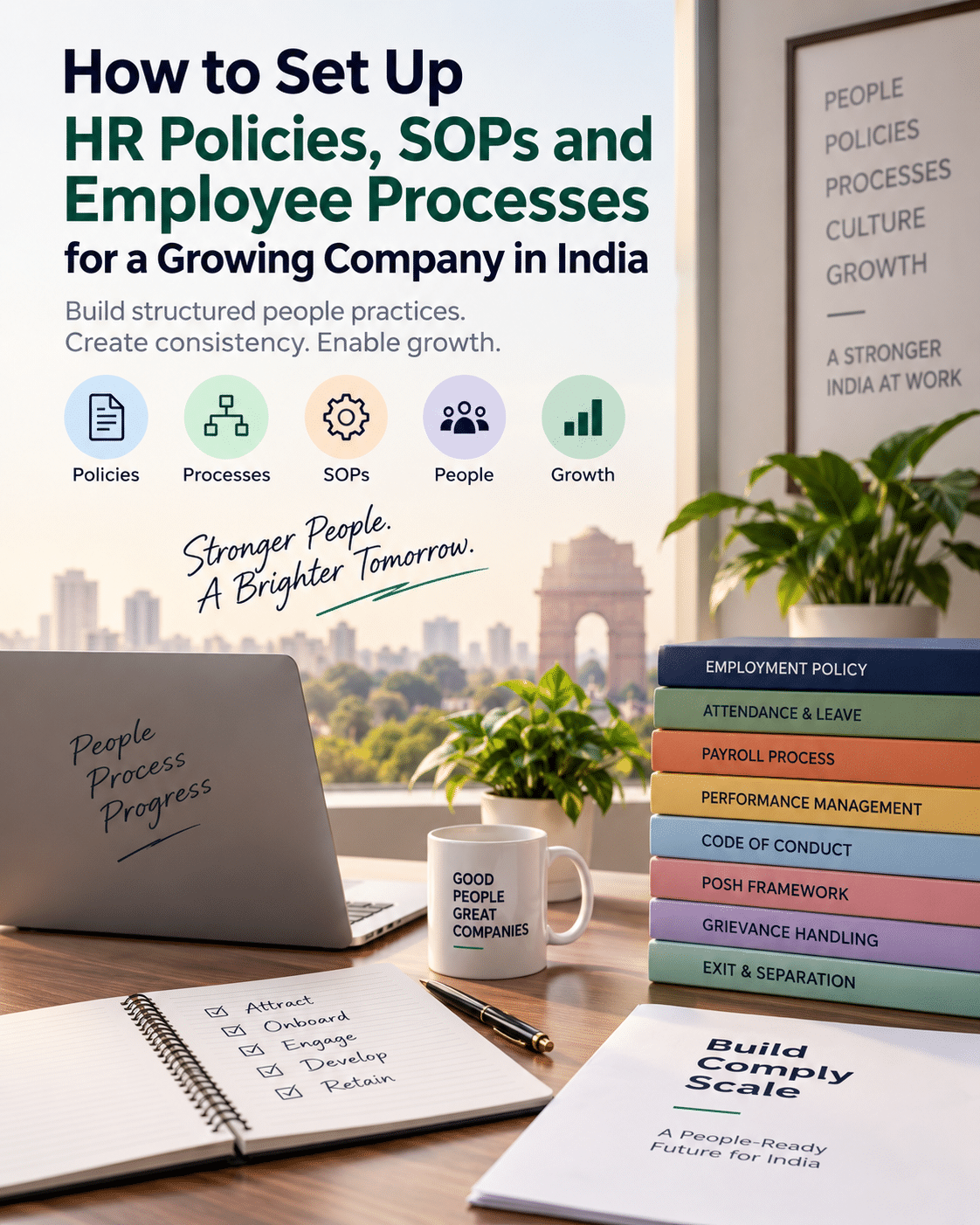
When a company has five or ten employees, many HR activities can be managed directly by the founders.
Leave may be approved over WhatsApp.
Attendance may be maintained in Excel.
Performance feedback may happen during casual conversations.
New employees may receive instructions directly from their manager.
This approach can work temporarily.
But once the organization grows, informal processes can become difficult to control.
Creating structured HR policies and procedures for companies helps transform people management from individual decisions into predictable and scalable organizational systems.
India’s current employment framework also makes formal HR systems increasingly relevant. The four Labour Codes became effective from 21 November 2025 and cover areas including wages, industrial relations, social security and occupational safety.
Growing organizations therefore need more than an employee handbook.
They need:
Policy + Process + SOP + Documentation + Ownership + Review
What Is an HR Policy?
An HR policy explains an organization’s rule, principle or position regarding an employee-related matter.
For example, a Leave Policy can explain:
- Leave categories
- Eligibility
- Conditions
- Employee responsibilities
- Approval requirements
The policy establishes what the rule is.
What Is an HR SOP?
An HR Standard Operating Procedure (SOP) explains exactly how an HR activity should be performed.
It may define:
- Steps
- Responsibility
- Approval
- Documentation
- System
- Timeline
- Record keeping
For example:
Leave Policy: Defines leave rules.
Leave SOP:
Employee Request → Manager Approval → HR Verification → Record Update → Payroll/Attendance Update
This distinction is important.
Many organizations have written policies but no defined process for implementing them.
Why Do Growing Companies Need HR SOPs?
As a company grows, more people become involved in employee management.
Structured processes help create:
- Consistency
- Clear ownership
- Faster decisions
- Improved employee experience
- Better documentation
- Easier delegation
- Reduced dependence on founders
- Better manager accountability
- Greater scalability
The objective is not unnecessary bureaucracy.
The objective is to make recurring HR activities repeatable and manageable.
Step 1: Audit Existing HR Practices
Before creating new policies, understand what the organization currently does.
Review:
- Recruitment
- Interviews
- Offers
- Appointment letters
- Onboarding
- Attendance
- Leave
- Payroll
- Performance
- Employee grievances
- Discipline
- Training
- Separation
Ask:
What happens in practice?
Then ask:
What does our policy say should happen?
The difference between those two answers reveals the process gaps.
Step 2: Identify Applicable Requirements
Your HR framework should consider:
- Employee count
- Industry
- Locations
- Establishment type
- Work arrangements
- Employee categories
- Shift patterns
- Contractual arrangements
The current Labour Code framework includes minimum-wage, timely-payment, employment-formalisation, social-security and workplace-safety provisions.
Avoid blindly copying policies from another company.
Step 3: Build Your HR Policy Framework
Start with your most important employee-management areas.
Common policies include:
Employment Policy
Define basic employment expectations and documentation.
Attendance Policy
Define working hours, attendance and regularization.
Leave Policy
Define leave categories and approval procedures.
Code of Conduct
Define workplace behaviour and ethical expectations.
Payroll Policy
Define payroll procedures and responsibilities.
Performance Policy
Define reviews and performance expectations.
Grievance Policy
Define how employees can raise concerns.
Confidentiality Policy
Define how organizational information should be protected.
Separation Policy
Define employee resignation and exit procedures.
POSH Framework
Implement required workplace sexual-harassment prevention and redressal mechanisms.
Government guidance states that Internal Committees are mandatory for workplaces with 10 or more employees.
Step 4: Convert Policies Into SOPs
This is the step many businesses miss.
Create a step-by-step workflow for every recurring HR process.
Recruitment SOP
- Manpower Requirement
- Approval
- Job Description
- Candidate Sourcing
- Screening
- Interview
- Selection
- Offer
- Joining
Onboarding SOP
- Pre-Joining Documentation
- Appointment Process
- Employee Setup
- System Access
- Orientation
- Policy Communication
- Manager Handover
- Initial Goals
Leave SOP
Employee Request
- Manager Review
- Approval
- HR Verification
- Attendance Update
Payroll SOP
Attendance Closure
- Salary Inputs
- Verification
- Approval
- Payroll Processing
- Payment
- Records
Performance SOP
Goal Setting
- Review
- Manager Feedback
- Employee Discussion
- Documentation
- Development Plan
Grievance SOP
Complaint
- Acknowledgement
- Review
- Escalation
- Resolution
- Documentation
Exit SOP
Resignation
- Acceptance
- Notice Period
- Handover
- Asset Clearance
- Access Revocation
- Final Payroll
- Exit Documentation
Step 5: Assign Ownership
Every important process should answer four questions:
Who owns this?
Who approves it?
Who contributes?
Who maintains records?
For example:
Employee applies for leave.
Manager approves.
HR verifies eligibility.
Payroll receives finalized leave/attendance data.
This removes confusion.
Step 6: Standardize HR Documentation
Businesses should avoid creating important documents from scratch every time.
Create approved templates for relevant activities such as:
- Appointment documentation
- Employee information
- Policy acknowledgements
- Probation reviews
- Performance reviews
- Warning communications
- Grievance records
- Asset handover
- Resignation acknowledgement
- Exit clearance
- Employee checklists
Current government guidance specifically highlights appointment letters as part of employment formalisation.
Step 7: Build an Effective Onboarding Process
Onboarding should help every new employee understand:
- Their role
- Reporting manager
- Company structure
- Policies
- Working hours
- Leave procedure
- Attendance
- Performance expectations
- Communication channels
- Grievance channels
A standardized onboarding checklist reduces dependence on individual managers.
Step 8: Create Attendance, Leave and Payroll Workflows
These processes affect employees every month.
Clearly define:
- Attendance system
- Correction process
- Leave approval
- Payroll cut-off
- Payroll inputs
- Deductions
- Reimbursements
- Verification
- Salary authorization
The current Labour Code framework includes minimum-wage and timely-payment protections.
Step 9: Build Performance Management
A basic but structured performance system is more useful than a complicated system nobody follows.
Start with:
Clear Job Description
Then establish:
Goals → Review → Feedback → Documentation → Development
A structured system helps managers make better decisions about:
- Recognition
- Development
- Promotion
- Salary review
- Performance improvement
Step 10: Create a Grievance Process
Employees should know how to raise serious concerns.
Clearly define:
- Reporting channel
- Acknowledgement
- Confidentiality
- Review process
- Escalation
- Documentation
- Resolution
A formal grievance process should not be confused with normal employee feedback.
Step 11: Implement Workplace Compliance Mechanisms
Policies need actual implementation.
For example, POSH compliance should not end after creating a policy document.
Where applicable, the organization needs the required Internal Committee, complaint process, employee awareness and appropriate procedures.
Government guidance confirms that an Internal Committee is mandatory for workplaces with 10 or more employees.
Employers should also assess social-security applicability.
Under current central government guidance, EPFO provisions apply to establishments employing 20 or more employees, while ESIC has mandatory coverage provisions for establishments having more than 10 employees, subject to the relevant framework and conditions.
Step 12: Build an Employee Exit Process
Employee exits can affect:
- Customers
- Data
- Intellectual property
- Payroll
- Company devices
- Business continuity
A structured exit process should address:
- Resignation
- Notice period
- Handover
- Asset return
- Access closure
- Final inputs
- Documentation
- Exit feedback
Step 13: Train Managers
Managers are often responsible for implementing HR policies.
Train them on:
- Leave approval
- Attendance
- Performance feedback
- Grievance escalation
- Disciplinary matters
- Confidentiality
- Documentation
Publishing a policy does not automatically mean managers know how to implement it.
Step 14: Communicate Policies to Employees
Employees should know:
- Where policies are available
- Which policies apply
- How processes work
- Whom to contact
- When policies change
Important updates should be communicated rather than silently replacing documents.
Step 15: Review Policies Periodically
Your HR framework should evolve with your business.
Review it when there are changes in:
- Law
- Workforce
- Locations
- Working models
- Management
- Organizational structure
- Technology
- Business processes
A policy created for 10 employees may not work for a 200-person organization.
When Should a Startup Formalize HR?
Do not wait until the company becomes very large.
Strong indicators include:
- Founders can no longer personally manage every employee
- Several managers are approving leave
- Employee decisions are inconsistent
- Hiring is accelerating
- Teams work across locations
- Employee complaints are increasing
- Payroll input is becoming complex
- Managers interpret company rules differently
A useful test is:
If two managers would handle the same situation differently, you probably need a policy or SOP.
Can a Startup Outsource HR Policy Development?
Yes.
Startups and SMEs can use external HR consultants to help build:
- HR policies
- SOPs
- Documentation
- Recruitment systems
- Onboarding
- Performance processes
- Employee frameworks
- Compliance processes
- HR governance
This can be particularly useful when the organization does not yet require a large in-house HR leadership team.
What Should an HR Policy Consultant Deliver?
An HR consulting engagement should provide more than generic Word documents.
Useful deliverables can include:
- Customized HR policies
- HR SOPs
- Process maps
- HR forms
- Checklists
- Responsibility matrices
- Employee documentation
- Onboarding system
- Performance framework
- Exit process
- Implementation guidance
The goal should be to create a system the business can actually use.
HR Policy, Process & Compliance Services from NexPari
NexPari supports startups, SMEs and growing organizations across India with structured HR Policy, Process & Compliance consulting.
Support can include:
- HR policy development
- HR policy review
- HR process mapping
- HR SOP creation
- Compliance assessments
- Employee documentation
- Recruitment frameworks
- Onboarding systems
- Performance management
- Grievance processes
- Exit processes
- Ongoing HR advisory
Build an HR Framework That Can Grow With Your Business
If your organization still depends on informal HR decisions, spreadsheets and individual managers, this may be the right time to formalize your HR system.
NexPari can help you develop practical HR policies, SOPs and employee processes designed around your organization’s requirements.
Primary CTA: Build Your HR Framework
Secondary CTA: Talk to an HR Consultant
WhatsApp Message:
Hello NexPari, we would like support in setting up HR Policies, SOPs and employee processes for our organization.
FAQs
What is an HR SOP?
An HR SOP is a Standard Operating Procedure that explains the steps, responsibilities, approvals and documentation required to perform an HR activity.
What is the difference between HR policy and HR SOP?
An HR policy establishes the rule. An SOP explains how that rule is implemented.
What HR policies should a startup have?
Startups commonly consider policies covering employment, attendance, leave, conduct, payroll, confidentiality, performance, grievances, separation and applicable workplace requirements.
When should a company create HR SOPs?
SOPs become particularly valuable as employee numbers, departments and management layers increase.
Can SMEs outsource HR policy development?
Yes. SMEs may engage HR consultants to create HR policies, SOPs, documentation and structured HR processes.
How do you build an HR process?
Start by defining the objective, steps, responsible people, approvals, documentation, system and review mechanism.
Does NexPari provide HR policy development?
Yes. NexPari provides HR Policy, Process & Compliance support as part of its HR consultancy services.
FAQ Schema Questions
What is an HR SOP?
An HR SOP is a documented procedure defining how an HR activity should be performed consistently.
What is the difference between HR policy and HR process?
A policy defines what the organization’s rule is, while a process explains how that rule is implemented.
Why do growing companies need HR SOPs?
SOPs improve consistency, accountability, documentation and scalability.
Can a startup outsource HR policy development?
Yes. An external HR consultant can help a startup develop policies, SOPs and employee processes appropriate to its structure.