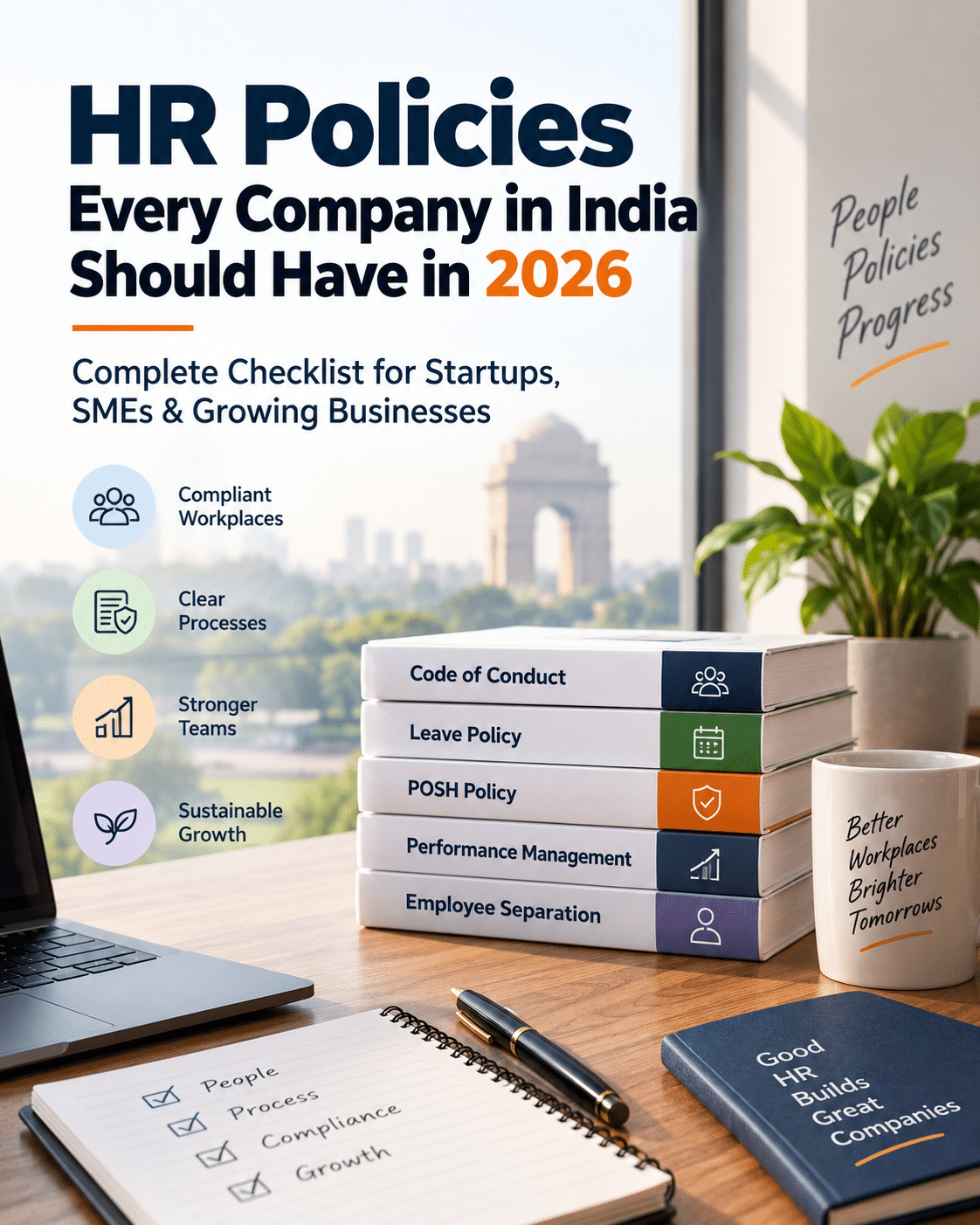
Every growing organization needs clear HR policies to manage employees consistently, establish workplace standards, improve documentation and build structured people-management processes.
If you are searching for HR policies for companies in India, it is important to understand that one generic HR handbook cannot suit every organization.
The HR policies needed by a business can vary according to its workforce size, industry, operating locations, employment structure and applicable Central and State requirements.
This has become even more important in 2026.
India’s four Labour Codes—the Code on Wages, 2019, Industrial Relations Code, 2020, Code on Social Security, 2020 and Occupational Safety, Health and Working Conditions Code, 2020—came into effect from 21 November 2025.
Government guidance highlights provisions relating to minimum wages, timely payment of wages, appointment letters, social security and workplace safety.
For employers, this means HR should not be managed only through informal instructions, spreadsheets and verbal decisions.
Organizations need a structured combination of:
HR Policy + HR Process + Documentation + Compliance + Review
What HR Policies Should a Company in India Have?
A growing company should generally consider policies covering:
- Employment terms
- Attendance and working hours
- Leave management
- Code of conduct
- Payroll and wages
- POSH and workplace conduct
- Grievance handling
- Performance management
- Disciplinary procedures
- Confidentiality
- Data and information handling
- Remote or hybrid working
- Employee separation
- Applicable statutory and social-security requirements
Not every policy is legally mandatory for every company in exactly the same form.
Applicability can depend on employee strength, industry, State, type of establishment and other factors.
The objective is to create policies relevant to your organization—not simply copy a generic handbook.
Why Are HR Policies Important?
Well-designed HR policies establish clear expectations for employees and managers.
They help organizations:
- Make consistent employee decisions
- Reduce confusion
- Define authority and responsibility
- Improve documentation
- Standardize HR processes
- Support workplace governance
- Improve onboarding
- Create better grievance mechanisms
- Strengthen performance management
- Scale HR operations as the company grows
Without documented policies, two managers may handle the same situation completely differently.
That can create inconsistency and employee dissatisfaction.
HR Policy Checklist for Indian Companies
1. Appointment and Employment Terms
Every employee should clearly understand the fundamental terms of employment.
Employment documentation may include:
- Designation
- Department
- Reporting manager
- Work location
- Compensation
- Employment category
- Probation terms where applicable
- Working conditions
- Relevant contractual terms
Current Labour Code guidance specifically highlights formalisation through appointment letters.
A structured appointment process also creates consistency between recruitment, onboarding, payroll and employee records.
2. Code of Conduct Policy
A Code of Conduct establishes standards for professional workplace behaviour.
It can address:
- Professional conduct
- Workplace ethics
- Conflicts of interest
- Confidentiality
- Organizational resources
- Communication standards
- Inappropriate behaviour
- Misconduct
- Compliance with organizational policies
This becomes increasingly important when several managers are responsible for different teams.
3. Attendance and Working Hours Policy
Employees should clearly understand how working time is managed.
The policy may cover:
- Office timings
- Attendance systems
- Weekly offs
- Late attendance
- Attendance regularization
- Shift arrangements
- Remote attendance
- Absence reporting
- Overtime where relevant
The actual framework should be reviewed against applicable requirements for the establishment and location.
4. Leave Policy
A structured Leave Policy explains:
- Available leave categories
- Eligibility
- Leave request procedures
- Approval authority
- Documentation requirements
- Unplanned absence
- Leave records
- Carry-forward or lapse provisions where applicable
Companies operating across multiple states should avoid assuming that the same leave framework automatically satisfies all locations.
5. Salary and Payroll Policy
Payroll affects every employee and should be supported by a documented process.
A payroll policy may address:
- Payroll cycle
- Salary cut-off
- Attendance inputs
- Reimbursements
- Authorized deductions
- Payroll approval
- Salary revisions
- Final settlement
The Labour Code framework provides protections relating to minimum wages and timely payment of wages.
6. POSH Policy
The Sexual Harassment of Women at Workplace framework is an important component of workplace governance.
Current government guidance states that an Internal Committee is mandatory for workplaces with 10 or more employees.
The policy and implementation framework should address:
- Prevention
- Employee awareness
- Reporting mechanism
- Internal Committee where applicable
- Complaint handling
- Confidentiality
- Inquiry processes
- Employer responsibilities
Having only a downloaded POSH PDF is not equivalent to implementing a complete POSH mechanism.
7. Grievance Redressal Policy
Employees should know exactly where they can raise workplace concerns.
The policy should clarify:
- Reporting channels
- Who receives grievances
- Escalation
- Confidentiality
- Documentation
- Follow-up
- Resolution responsibilities
A structured process can help resolve concerns before they turn into larger workplace conflicts.
8. Performance Management Policy
Performance management should not begin only after an employee starts underperforming.
A good policy may define:
- Job expectations
- KPIs or KRAs
- Review frequency
- Manager feedback
- Employee feedback
- Performance documentation
- Development plans
- Performance improvement processes
For smaller organizations, the process can remain simple while still being structured.
9. Disciplinary Action Policy
Businesses need a consistent process for dealing with serious policy violations or misconduct.
The policy may establish:
- Categories of misconduct
- Reporting
- Preliminary review
- Investigation where appropriate
- Employee response
- Approval authority
- Warnings
- Documentation
- Escalation
Managers should not handle serious disciplinary situations only through informal conversations.
10. Confidentiality Policy
Employees may have access to:
- Customer information
- Employee data
- Financial information
- Internal strategies
- Passwords
- Pricing
- Business processes
- Intellectual property
A confidentiality policy should establish how sensitive organizational information is accessed, used, shared and protected.
11. Information Security and Data Handling Policy
With remote work and cloud-based tools becoming common, companies should define expectations for:
- Passwords
- Company email
- Shared drives
- Employee devices
- Customer files
- Access rights
- External sharing
- Data storage
- Access removal on exit
This policy should reflect the organization’s actual technology environment.
12. Remote and Hybrid Work Policy
Where remote or hybrid work is allowed, employers should define:
- Eligibility
- Working hours
- Availability
- Reporting
- Attendance
- Information security
- Company equipment
- Performance expectations
- Office attendance requirements
The objective is to remove ambiguity.
13. Employee Separation Policy
Employee exits require the same level of process discipline as onboarding.
The policy may address:
- Resignation
- Notice requirements
- Handover
- Company assets
- Knowledge transfer
- Access revocation
- Exit clearance
- Documentation
- Final settlement
A structured exit process supports continuity and information security.
14. Social Security and Statutory Compliance
Organizations should review statutory applicability based on their specific circumstances.
Government guidance issued in 2026 states that EPFO provisions apply to establishments employing 20 or more employees, while ESIC mandatory coverage under the current Labour Code framework applies to establishments having more than 10 employees, subject to relevant conditions and exceptions.
Actual applicability should always be checked according to the organization’s circumstances and current notifications.
Are All HR Policies Mandatory in India?
No single rule requires every organization to maintain an identical employee handbook containing exactly the same HR policies.
Different requirements may apply depending on:
- Employee count
- Industry
- Establishment type
- Location
- Nature of work
- Employee category
- Applicable Central and State rules
For example, the POSH framework requires an Internal Committee for workplaces with 10 or more employees.
Companies should therefore avoid treating downloadable templates as automatic compliance solutions.
How Should HR Policies Be Created?
A practical HR policy development process follows these steps:
1. Assess current practices
Understand how the organization currently manages employees.
2. Identify gaps
Compare policies, actual processes and applicable requirements.
3. Prioritize policies
Start with the areas that have the highest employee or compliance impact.
4. Draft practical policies
Policies should reflect how the company actually intends to operate.
5. Create SOPs
Explain exactly how every important policy will be implemented.
6. Assign ownership
Identify who approves, executes and records each HR process.
7. Communicate
Employees and managers need to understand the policies.
8. Review
Policies should evolve as the organization and regulatory environment change.
HR Policy vs HR Process: What Is the Difference?
An HR policy defines the organization’s rule.
An HR process defines how that rule is implemented.
For example:
Leave Policy: Explains leave categories and rules.
Leave Process: Explains how an employee applies, who approves it and how HR records it.
This is why companies need HR Policy, Process & Compliance together.
When Should You Hire an HR Policy Consultant?
External HR consulting may be useful when:
- Your workforce is growing rapidly
- Policies are outdated
- HR decisions are inconsistent
- You are opening new locations
- Employee documentation is incomplete
- Founders still handle all HR decisions
- Managers use different HR practices
- The company needs formal SOPs
- Compliance requirements are unclear
- You are creating an HR function from scratch
HR Policy, Process & Compliance Support from NexPari
NexPari supports startups, SMEs, companies and growing organizations across India with structured HR Policy, Process & Compliance services.
Support can include:
- Existing HR policy review
- HR policy development
- HR process mapping
- HR SOP development
- Compliance gap review
- Employee documentation
- Onboarding processes
- Performance frameworks
- Grievance processes
- Exit processes
- Ongoing HR advisory
Need to Build or Review Your HR Policies?
If your organization is growing but your HR policies and processes are still informal, it may be the right time to create a structured HR framework.
NexPari can help you build customized HR policies, processes and SOPs designed around your organization.
CTA Button: Get an HR Policy & Compliance Review
Secondary CTA: Talk to Our HR Experts
WhatsApp Message:
Hello NexPari, I would like to discuss HR Policy, Process & Compliance services for our organization.
FAQs
What HR policies should every company in India have?
Companies should consider policies covering employment terms, attendance, leave, workplace conduct, payroll, POSH, grievance handling, performance management, confidentiality, disciplinary processes and employee exits.
Are HR policies mandatory for startups?
Startups must comply with requirements applicable to their establishment, although every HR policy is not universally mandatory in exactly the same format.
Is an Internal Committee mandatory under POSH?
Government guidance states that an Internal Committee is mandatory for workplaces with 10 or more employees.
Why should small businesses have HR policies?
Written policies help create consistency before the workforce becomes difficult to manage through informal decisions.
Can I use HR templates downloaded online?
They may provide a starting point, but they should be customized for your workforce, industry, operating locations and applicable requirements.
What does an HR policy consultant do?
An HR policy consultant assesses HR practices, identifies gaps, develops policies, designs SOPs and helps organizations implement structured HR systems.
Does NexPari provide HR Policy, Process & Compliance services?
Yes. NexPari provides HR consulting support for organizations looking to develop or improve HR policies, employee processes, SOPs and HR frameworks.
FAQ Schema Questions
What HR policies should every company in India have?
Companies commonly consider policies covering employment, attendance, leave, conduct, payroll, workplace safety, grievances, performance, confidentiality and employee exits.
What is the difference between an HR policy and an HR process?
An HR policy defines a rule, while an HR process defines how that rule is implemented operationally.
Can startups outsource HR policy development?
Yes. Startups can engage external HR consultants to develop policies, SOPs and employee-management processes.