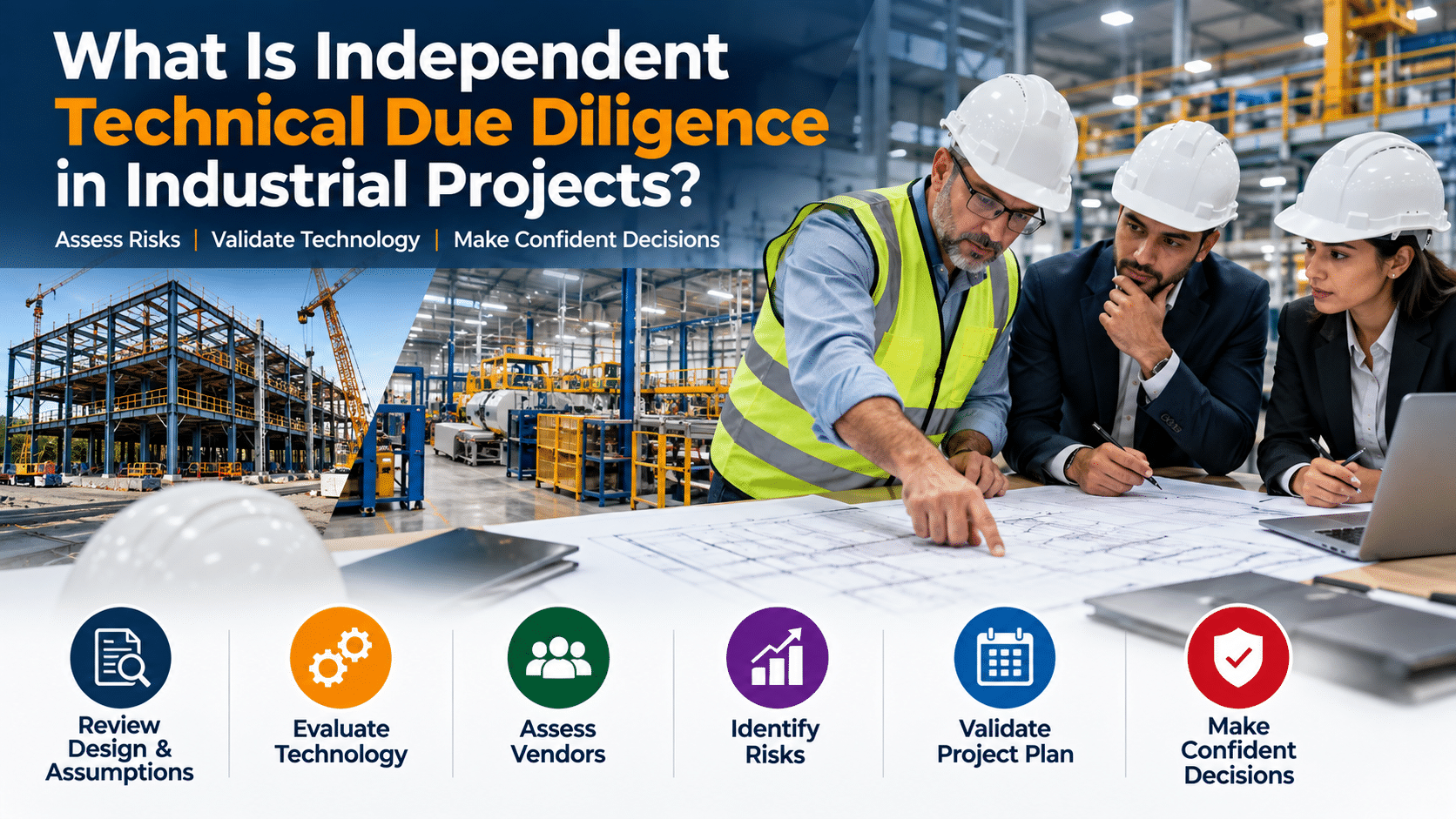
Independent Technical Due Diligence is a structured engineering review that helps industrial project owners assess technology, design, vendor capability, project risks and technical readiness before committing major CAPEX or moving into execution.
This independent review helps management identify technical gaps, challenge critical assumptions and make better-informed decisions before issues become expensive during procurement, installation or commissioning.
It helps project owners, management teams, investors and engineering leaders answer a critical question:
Are we technically confident enough to proceed?
That question may arise before approving CAPEX, selecting a technology, appointing a vendor, acquiring an industrial facility, financing a project or moving from concept into detailed engineering and execution.
Technical due diligence is not simply an exercise in finding faults. Its real purpose is to identify assumptions, gaps, uncertainties and technical risks before they become expensive project problems.
In complex industrial projects, even a well-prepared proposal can contain hidden risks related to capacity, equipment performance, interfaces, project schedule, commissioning or maintainability. An independent review helps bring those issues into focus while there is still time to take corrective action.
Why Is Technical Due Diligence Important in Industrial Projects?
Industrial projects rarely fail because of one single mistake.
Problems are often created by several smaller gaps that were not identified early enough.
For example, a production line may be designed using unrealistic throughput assumptions. A warehouse automation system may appear technically strong but be unsuitable for the actual SKU profile. A utility system may be undersized. Two vendors may assume that the other party is responsible for a critical interface.
These gaps often become visible only during installation or commissioning, when changes are more difficult and costly.
Independent technical due diligence helps identify these issues before major commitments are made.
It can support better decisions in areas such as:
- Technology selection
- Equipment sizing
- Vendor selection
- Project feasibility
- Design validation
- CAPEX approval
- Project risk assessment
- Project scheduling
- Commissioning planning
- Operational readiness
The earlier important technical risks are identified, the more options the project team usually has to address them.
What Does “Independent” Technical Due Diligence Mean?
The word independent is important.
Technology suppliers naturally understand their own systems and products.
EPC contractors focus on delivering the project within their contractual scope.
OEMs focus on equipment design and performance.
Internal engineering teams may already have experience or preferences based on previous projects.
All of these parties provide valuable input, but the project owner may still need an objective view from someone who is not commercially tied to a specific technology, vendor or system.
An independent technical advisor can challenge the project from the owner’s perspective.
Typical questions include:
- Is the technology suitable for the actual operating requirement?
- Are capacity calculations realistic?
- Are vendor assumptions supported by data?
- Is the design sufficiently mature?
- Are system interfaces clearly defined?
- Can the equipment achieve the promised performance?
- Is the project schedule achievable?
- Are lifecycle and maintenance requirements understood?
- What happens when critical equipment fails?
- Is future expansion possible?
Independent review does not mean working against vendors or contractors.
It means adding another layer of objective technical validation.
When Should Technical Due Diligence Be Conducted?
There is no single stage at which every project must conduct technical due diligence.
The right timing depends on the decision being made.
Before CAPEX Approval
A major industrial investment should ideally be supported by more than a high-level business case.
Management may want confidence that the technology, capacity, scope and project execution assumptions are technically credible before committing significant capital.
An independent review can help determine whether the proposed investment is aligned with the business requirement.
Before Technology Selection
Many industrial projects involve several possible technologies.
For example:
- ASRS vs conventional storage
- AMR vs AGV
- Robotics vs manual handling
- Different processing technologies
- Multiple production-line concepts
Technical due diligence can help assess these alternatives objectively.
The question should not be which technology looks more advanced.
The question should be which technology best fits the actual operational requirement.
Before Vendor Finalization
Different vendors may claim to meet the same specification while proposing very different technical solutions.
An independent review can compare:
- Technical compliance
- Equipment performance
- System architecture
- Interfaces
- Scalability
- Maintainability
- Software requirements
- Testing methodology
- Lifecycle support
This helps project owners compare proposals on more than just initial CAPEX.
Before Acquiring an Industrial Asset
If a company is acquiring a manufacturing plant, warehouse or industrial facility, technical due diligence can help evaluate what is being purchased.
The review may assess:
- Asset condition
- Remaining useful life
- Capacity
- Technology condition
- Maintenance history
- Upgrade requirements
- Bottlenecks
- Future CAPEX
- Obsolescence risk
This can help management understand the technical implications of the acquisition before final commitment.
Before Financing
Investors and lenders may require an independent engineering view before relying on the assumptions behind a major project.
A technical review can help assess whether the proposed technology, schedule, construction plan and operational assumptions are credible.
Before a Major Project Gate
Large industrial projects often move through multiple stages such as:
Concept → Basic Engineering → Detailed Engineering → Procurement → Execution → Commissioning
Technical due diligence can be used before critical gates to determine whether the project is mature enough to move forward.
What Does Technical Due Diligence Review?
The exact scope should always be customized for the project, but a robust review generally examines several important areas.
1. Business and Operational Requirements
The review should begin by understanding what the project is expected to achieve.
This may include:
- Production capacity
- Warehouse throughput
- Quality requirements
- Product mix
- Order profile
- Operating hours
- Reliability expectations
- Future expansion
- Service-level requirements
A technically impressive solution is still the wrong solution if it does not meet the business requirement.
2. Design Basis and Engineering Assumptions
Every project is built on assumptions.
These assumptions should be documented and challenged.
The review may ask:
- What capacity is the design based on?
- What peak conditions have been considered?
- What margins are included?
- Which engineering standards apply?
- Which assumptions are confirmed?
- Which assumptions still require validation?
Unclear assumptions can create problems later in design and execution.
3. Technology Suitability
Technology should be evaluated in the context of the actual application.
Important questions may include:
- Is the technology proven?
- Has it been used in similar environments?
- Does it match the required throughput?
- Can it scale?
- Is local support available?
- Is the system highly proprietary?
- What is the risk of obsolescence?
- Is the technology appropriate for the operating environment?
A technology may work very well in one industry but perform poorly in another if the operating conditions are different.
4. Capacity and Performance
The project should be evaluated against real operational demand.
Technical due diligence may review:
- Production rate
- Warehouse throughput
- Equipment cycle time
- System availability
- Utilisation
- Peak demand
- Recovery time
- Capacity margins
Average throughput alone is not enough.
A system should also be reviewed under peak and failure scenarios.
5. Layout and Material Flow
Many industrial inefficiencies occur because systems are designed individually rather than as one integrated operation.
A technical review may assess:
- Material flow
- Equipment positioning
- Maintenance access
- Operator access
- Forklift routes
- Pedestrian movement
- Storage zones
- Process interfaces
- Bottlenecks
The objective is to determine whether the layout supports efficient and practical operation.
6. Utilities and Infrastructure
Equipment performance depends on the infrastructure supporting it.
The review may examine:
- Electrical capacity
- Compressed air
- Water supply
- HVAC
- Network infrastructure
- Fire protection
- Structural capacity
- Floor loading
- Drainage
- Access
This is particularly important in brownfield projects where existing infrastructure may create limitations.
7. Vendor and OEM Capability
Technical due diligence should not focus only on equipment specifications.
The supplier’s ability to deliver and support the solution also matters.
Important factors include:
- Relevant installed base
- Engineering capability
- Manufacturing capability
- Quality systems
- Technical support
- Spare parts availability
- Commissioning capability
- Software support
- Project experience
A strong technical concept can still fail if the supplier cannot execute it effectively.
8. Project Interfaces
Industrial projects often involve multiple vendors, systems and contractors.
The review should identify interface boundaries clearly.
Typical questions include:
- Who supplies the controls?
- Who integrates the software?
- Who is responsible for field wiring?
- Who owns the interface between the machine and WMS?
- Who validates communication?
- Who is responsible for performance integration?
Unclear interface ownership is a common source of project delays.
9. Project Schedule
A technically sound project can still fail because of an unrealistic schedule.
The review may examine:
- Engineering duration
- Long-lead items
- Manufacturing
- Factory testing
- Site preparation
- Installation
- Integration
- SAT
- Commissioning
- Ramp-up
Project teams should also consider realistic contingency for technical issues.
10. Maintainability and Lifecycle Requirements
Industrial equipment should not be designed only for successful commissioning.
It should be practical to operate and maintain over many years.
Important questions include:
- Can equipment be safely accessed?
- Are critical spare parts available?
- Are diagnostic tools available?
- Is OEM support required for routine faults?
- What are replacement cycles?
- Are maintenance routes adequate?
- Is the system heavily dependent on proprietary components?
Maintainability should be part of the design discussion from the beginning.
11. Testing and Acceptance Criteria
A project should clearly define how performance will be verified.
Acceptance criteria may include:
- Functional tests
- Throughput tests
- Safety tests
- Interface tests
- Accuracy tests
- Availability tests
- Recovery tests
- Performance guarantees
These criteria may later be used during FAT and SAT.
Vague acceptance criteria create unnecessary disputes during project handover.
12. Commissioning and Operational Readiness
Installation does not mean the system is ready for operation.
A due-diligence review should consider:
- Commissioning sequence
- SOPs
- Operator training
- Maintenance training
- Spares
- Handover documentation
- Defect closure
- Ramp-up plan
- Performance monitoring
The project should have a realistic path from installation to stable operation.
Common Technical Red Flags in Industrial Projects
Experienced reviewers often identify recurring patterns.
Unclear Requirements
If vendors are working with different assumptions, their proposals cannot be compared fairly.
Unsupported Performance Claims
A vendor may claim high capacity without showing how the figure was calculated or validated.
Poorly Defined Interfaces
Multiple suppliers may assume that another party is responsible for critical integration work.
Vague Acceptance Criteria
Statements such as “system shall perform satisfactorily” are difficult to test objectively.
Unrealistic Commissioning Schedules
Projects often underestimate the time required for debugging, integration and ramp-up.
Weak Maintenance Planning
Equipment may be difficult to access, diagnose or repair after installation.
Single Points of Failure
A single machine, server, conveyor or control system may be capable of stopping the entire operation.
No Expansion Strategy
The system may meet today’s requirement but leave no practical route for future growth.
These risks are much easier to manage before equipment is ordered or installed.
Technical Due Diligence vs Design Review
These terms are related, but they are not the same.
A design review primarily evaluates engineering design.
It may examine:
- Drawings
- Calculations
- Layouts
- Specifications
- Engineering standards
Technical due diligence is broader.
It may include design review, but it also considers:
- Technology
- Capacity
- Vendor capability
- Project schedule
- Integration
- Maintainability
- Testing
- Commissioning
- Technical risk
- Lifecycle implications
A design review may therefore be one part of a wider due-diligence exercise.
Technical Due Diligence vs Technical Assurance
Technical due diligence and technical assurance also serve different purposes.
Technical Due Diligence usually supports a decision.
It helps answer:
Should the project proceed, and what issues must be addressed first?
Technical Assurance supports confidence during delivery.
It may include:
- Engineering reviews
- Equipment inspections
- OEM compliance reviews
- FAT
- SAT
- Supplier quality assurance
- Commissioning oversight
A project may therefore move through the following sequence:
Technical Due Diligence → Technology Selection → Vendor Selection → Detailed Engineering → Technical Assurance → FAT → SAT → Commissioning
What Should a Technical Due Diligence Report Include?
A useful due-diligence report should help both technical teams and senior management make decisions.
It should typically include:
Executive Summary
A concise overview of the most important findings.
Technical Status
An assessment of project maturity and technical readiness.
Key Assumptions
A list of important assumptions and their current validation status.
Risk Register
A structured list of technical risks and their potential impact.
Priority Findings
Issues may be categorized as:
- Critical
- High
- Medium
- Low
Recommended Actions
Each important finding should have a clear next step.
Open Items
Any missing information should be documented.
Decision Impact
The report should explain whether a finding could affect:
- CAPEX
- OPEX
- Schedule
- Capacity
- Quality
- Safety
- Reliability
- Commissioning
A long report has limited value if management still cannot understand what decision needs to be made.
How Technical Due Diligence Applies to Warehouse Automation
Warehouse automation is a good example of where independent technical due diligence can add value.
Consider an organization planning a large ASRS installation with conveyors, AMRs and software integration.
The review may examine:
- SKU profile
- Storage capacity
- Throughput
- Peak demand
- Equipment availability
- Redundancy
- Conveyor bottlenecks
- WMS/WCS integration
- Fire system interfaces
- Maintenance access
- Expansion requirements
- FAT criteria
- SAT criteria
- Vendor boundaries
- Commissioning strategy
The important question is not whether ASRS is a good technology.
The real question is:
Is this ASRS solution appropriate for this warehouse, this material flow and this investment?
That is the purpose of independent review.
Greenfield vs Brownfield Technical Due Diligence
The review approach changes depending on the project environment.
Greenfield Projects
A greenfield project provides more flexibility.
Technical due diligence can influence:
- Technology selection
- Layout
- Infrastructure
- Utilities
- Capacity
- Building design
- Expansion
- Vendor strategy
Many major decisions can still be changed at this stage.
Brownfield Projects
Brownfield projects often carry more hidden constraints.
The review may need to consider:
- Existing equipment
- Legacy software
- Structural restrictions
- Shutdown windows
- Utility limitations
- Existing operations
- Old documentation
- Integration challenges
- Business continuity
The goal is to ensure that the new solution can realistically coexist with the existing operation.
Who Should Perform Independent Technical Due Diligence?
The reviewer should have experience relevant to the project.
Depending on the scope, technical due diligence may require expertise in:
- Mechanical engineering
- Electrical engineering
- Automation
- Controls
- Industrial engineering
- Process engineering
- Project management
- Quality
- Commissioning
The reviewer should also understand how individual systems work together.
Independent technical due diligence is most valuable when the reviewer can challenge technologies and vendors without being tied to a specific commercial solution.
How NexPari Supports Independent Technical Due Diligence
NexPari supports complex industrial projects through independent Engineering Advisory and Technical Assurance.
Its Engineering Advisory scope can include:
- Engineering Design Review
- Technology Evaluation
- Vendor Selection Support
- Technical Due Diligence
- Automation Strategy
- Design Risk Assessment
- Execution Advisory
This can help industrial organizations evaluate important technical decisions before major investments are committed.
The support can continue beyond the due-diligence stage through areas such as:
- Owner’s Engineering
- Technical Assurance
- Vendor coordination
- Engineering review
- FAT
- SAT
- Commissioning oversight
- Operational readiness
This creates a more connected project lifecycle:
Technical Due Diligence → Decision → Vendor Selection → Engineering Review → Technical Assurance → FAT/SAT → Commissioning
When Should You Consider an Independent Technical Review?
Independent technical due diligence may be useful when:
- The proposed CAPEX is significant
- The project involves unfamiliar technology
- Multiple vendors are being compared
- The project has complex integration requirements
- A facility is being acquired or modernized
- Management needs an independent technical opinion
- Project assumptions have not been formally challenged
- A major project gate is approaching
- The team wants to reduce execution uncertainty before commitment
Early technical review creates more flexibility because the project team can still adjust requirements, technology or vendor strategy before the investment becomes difficult to change.
Final Takeaway
Independent technical due diligence is not simply an engineering audit.
It is a structured decision-support process.
Its purpose is to help project owners understand whether technical assumptions are credible, whether important risks have been identified and whether the project is mature enough to proceed.
A strong due-diligence review should provide clear answers to five questions:
What is technically sound?
What requires correction?
What information is still missing?
What risks remain?
What should happen before the next major decision?
For industrial organizations planning automation, new equipment, facility expansion or complex CAPEX programs, this clarity can help reduce technical uncertainty and improve project decision-making.
CTA
Planning a Major Industrial Project or Technology Investment?
Before committing CAPEX, finalizing a technology or appointing a major vendor, an independent technical review can help identify critical issues while there is still time to address them.
Talk to NexPari for independent Technical Due Diligence and Engineering Advisory support.
Primary CTA: Request a Technical Due Diligence Review
Secondary CTA: Talk to an Engineering Advisor
WhatsApp Message:
Hello NexPari, we are evaluating an industrial project and would like to discuss independent Technical Due Diligence and Engineering Advisory support.
Frequently Asked Questions
What is technical due diligence in industrial projects?
Technical due diligence is a structured assessment of a project’s technology, engineering, capacity, vendors, infrastructure, execution assumptions and technical risks before a major investment or project decision.
Why should technical due diligence be independent?
An independent reviewer can evaluate the project from the owner’s perspective without being commercially tied to a particular vendor, technology or equipment supplier.
When should technical due diligence be conducted?
It is commonly useful before CAPEX approval, technology selection, vendor appointment, financing, asset acquisition or major project stage gates.
What areas are reviewed during technical due diligence?
Typical areas include design basis, technology, capacity, utilities, vendors, layout, interfaces, schedule, maintainability, testing, commissioning and technical risk.
Is technical due diligence the same as a design review?
No. Design review focuses mainly on engineering design, while technical due diligence assesses the broader technical viability and risk profile of the project.
Is technical due diligence the same as Technical Assurance?
No. Technical due diligence generally supports major decisions, while Technical Assurance provides independent verification during project engineering, manufacturing, testing and delivery.
Can technical due diligence be used for warehouse automation?
Yes. It can evaluate storage assumptions, throughput, automation technology, system architecture, vendor proposals, interfaces, redundancy, testing and commissioning plans.
Does NexPari provide Technical Due Diligence support?
Yes. NexPari provides Engineering Advisory services that can include Technical Due Diligence, technology evaluation, vendor review, design assessment and broader technical decision support.
FAQ Schema Questions
What is independent technical due diligence?
Independent technical due diligence is an objective engineering review used to assess technical feasibility, assumptions, risks and project readiness before a major industrial decision.
When is technical due diligence required?
It may be useful before CAPEX approval, technology selection, vendor finalization, financing, asset acquisition or major project stage gates.
What is reviewed during technical due diligence?
Typical areas include technology, engineering design, capacity, utilities, vendors, project interfaces, schedule, maintainability, testing, commissioning and technical risk.
What is the difference between technical due diligence and Technical Assurance?
Technical due diligence primarily supports decisions, while Technical Assurance supports verification during project execution and delivery.
Who performs technical due diligence?
It is typically performed by experienced engineering specialists or independent technical advisors with relevant industry and project experience.