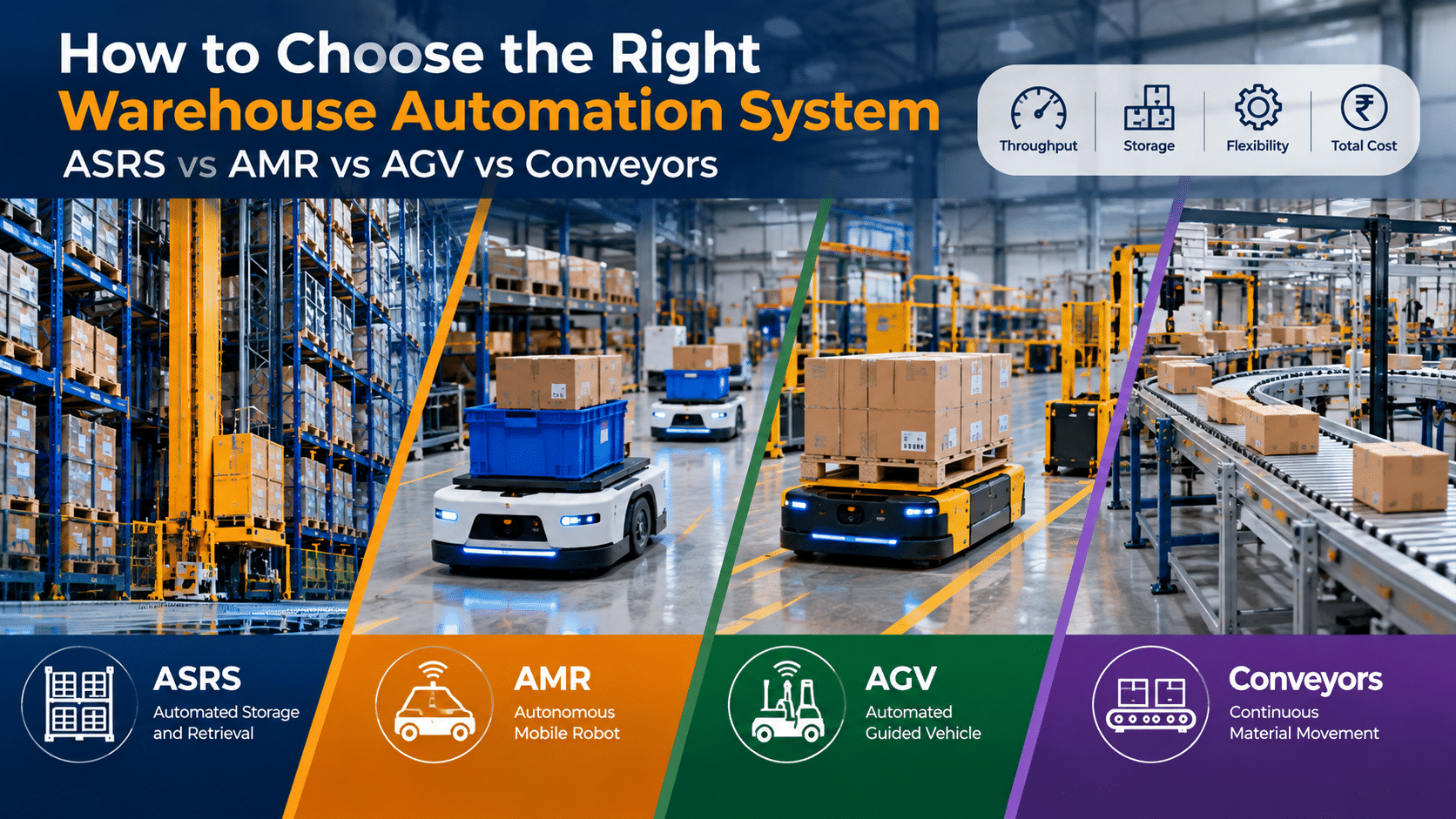
Choosing between ASRS, AMRs, AGVs and conveyors should begin with the warehouse’s operational requirements—not with a particular technology or vendor.
In simple terms, ASRS automates storage and retrieval, AMRs provide flexible autonomous material movement, AGVs handle repeatable guided transportation, and conveyors provide continuous movement along fixed paths.
None of these technologies is universally better than the others.
The right warehouse automation system depends on factors such as throughput, SKU profile, inventory volume, storage density, order patterns, facility layout, process stability, software architecture, expansion plans and lifecycle cost.
In many modern facilities, the best solution is not a single technology at all. A warehouse may combine ASRS for high-density storage, conveyors for predictable high-volume transport and AMRs for flexible movement between operational zones.
For companies considering warehouse automation in India, technology selection is becoming increasingly important as logistics and industrial facilities move toward technology-enabled infrastructure. CBRE’s 2026 India logistics outlook specifically highlights continued automation adoption and technology-driven warehousing development.
The challenge is therefore not simply whether to automate, but how much to automate and which technology architecture best supports the business case.
ASRS vs AMR vs AGV vs Conveyors: Quick Comparison
| Technology | Primary Role | Best Fit | Flexibility | Infrastructure Requirement |
|---|---|---|---|---|
| ASRS | Automated storage and retrieval | High-density inventory and goods-to-person systems | Medium | High |
| AMR | Flexible autonomous transport | Dynamic warehouse workflows | High | Low–Medium |
| AGV | Guided point-to-point movement | Stable, repetitive material transport | Medium | Medium |
| Conveyor | Continuous fixed-route movement | High-volume predictable flow | Low | Medium–High |
This comparison is only a starting point. The final selection should be supported by operational data and engineering analysis.
What Is ASRS and When Should You Use It?
ASRS stands for Automated Storage and Retrieval System. It uses computer-controlled equipment to automatically place inventory into storage locations and retrieve it when required.
ASRS systems can include pallet cranes, mini-load systems, shuttles, vertical lift modules, carousels and cube-based storage solutions. MHI describes ASRS as equipment-and-control combinations designed to automatically handle, store and retrieve materials with precision and speed.
ASRS is particularly valuable when the primary problem involves storage density, retrieval speed or excessive travel inside storage areas.
Typical applications include:
- Pallet warehouses
- High-bay storage facilities
- Tote and carton storage
- Spare-parts warehouses
- Finished-goods facilities
- Goods-to-person picking
- Manufacturing buffers
- Distribution centres
One of ASRS’s strongest advantages is its ability to use vertical cube more effectively than conventional shelving or racking. MHI also notes that high-density storage and improved space utilisation are major reasons organizations consider ASRS.
However, ASRS generally requires significant upfront engineering.
The project team must carefully define load sizes, SKU profile, throughput, aisle configuration, fire strategy interfaces, floor requirements, maintenance access and expansion requirements.
An ASRS designed around incorrect assumptions can become difficult and expensive to change later.
Choose ASRS when:
Your operation has a relatively well-defined storage profile, high inventory density, predictable handling units and a strong business case for automated storage and retrieval.
What Is an AMR and When Is It the Better Choice?
AMR stands for Autonomous Mobile Robot. An AMR transports materials through a facility while dynamically navigating between destinations using onboard computing, sensors and mapping technologies.
Unlike traditional guided vehicles, AMRs do not normally depend entirely on fixed physical paths.
If an obstacle blocks the normal route, an AMR can often calculate an alternative route.
MHI identifies this routing flexibility as one of the key differences between AMRs and conventional AGVs.
AMRs can support:
- Tote movement
- Picking operations
- Cart transport
- Production-line replenishment
- Material delivery
- Goods-to-person applications
- Movement between warehouse zones
- Transfer between automated systems
They can be especially useful in brownfield warehouses where installing extensive fixed conveyor infrastructure would create disruption.
AMRs are also relatively scalable. An operation can sometimes begin with a smaller fleet and add additional robots as volumes increase, subject to traffic, software and charging requirements.
However, AMRs still need careful engineering.
Fleet size, congestion, charging strategy, Wi-Fi/network reliability, pedestrian interaction, battery strategy and software integration all influence real-world performance.
Choose AMRs when:
Material destinations change frequently, flexible routing is important, phased implementation is preferred or the building cannot easily accommodate extensive fixed automation.
What Is an AGV and When Does It Make Sense?
AGV stands for Automated Guided Vehicle. It is a driverless material-handling vehicle designed to transport loads along controlled or predefined routes.
AGVs have been widely used in industrial environments for repetitive material movement.
Examples include transporting:
- Raw materials to production
- Components between workstations
- Finished goods to warehouses
- Pallets between conveyors
- Material between ASRS and production areas
MHI notes that AGVs are particularly well suited to predictable environments with repetitive point-to-point movements.
A common misunderstanding is that AMRs automatically make AGVs obsolete.
They do not.
If a factory has a stable route and needs the same load moved between the same two points hundreds of times each shift, an AGV can be entirely appropriate.
The question is not which technology is newer.
The question is which technology best matches the process.
Choose AGVs when:
The process is stable, routes are predictable, loads are consistent and repeatable point-to-point transport is the main requirement.
When Should You Choose Conveyors?
Conveyors move cartons, totes, pallets or products continuously along a defined physical route.
Although mobile robotics receives significant attention, conveyors remain one of the most effective warehouse automation technologies for high-volume, repetitive flow.
A typical process might be:
Picking → Consolidation → Packing → Sortation → Dispatch
If thousands of cartons repeatedly follow this same route, a conveyor may be more appropriate than deploying mobile robots for every transport movement.
Conveyors may also integrate with:
- Barcode scanners
- Weighing systems
- Label applicators
- Sorters
- ASRS
- Robotic cells
- Packing systems
- Palletizers
Fixed infrastructure can be a disadvantage when workflows change frequently, but it becomes an advantage when the process is highly stable and high throughput is required.
MHI’s warehouse-automation guidance also treats conveyors as a practical entry point for automating repetitive material movement.
Choose conveyors when:
Material follows predictable routes, volumes are high, continuous flow is needed and the warehouse layout is relatively stable.
ASRS vs AMR: Which Is Better?
This is one of the most common warehouse automation questions, but ASRS and AMRs solve fundamentally different problems.
ASRS primarily solves a storage-and-retrieval problem.
AMRs primarily solve an internal transportation problem.
For example, an automated facility could use:
High-Bay ASRS → Retrieval Station → AMR → Production Area
The ASRS retrieves the pallet or tote.
The AMR transports it to the next operational destination.
Therefore, businesses should avoid treating ASRS vs AMR as a simple winner-versus-loser comparison.
Ask instead:
Where is inventory stored, how should it be retrieved, and how should it move after retrieval?
The answer may require both.
AMR vs AGV: What Is the Main Difference?
The biggest practical difference is navigation flexibility.
AGVs generally operate through predefined or controlled routes.
AMRs can dynamically calculate routes and navigate around obstacles.
MHI describes AGVs as particularly suited to repetitive, predictable movements, while AMRs are more suitable when operating environments require flexibility.
Imagine two facilities.
In an automotive factory, components travel from warehouse location A to production station B hundreds of times each day.
The route rarely changes.
An AGV may work very well.
Now consider an e-commerce fulfilment facility where robots must visit numerous storage or picking areas depending on real-time orders.
An AMR architecture may provide more flexibility.
Neither is universally superior.
Conveyor vs AMR: How Should You Decide?
Compare flow stability.
If 2,000 cartons need to travel through exactly the same process route every hour, fixed conveyor infrastructure can be highly effective.
If materials need to visit different destinations depending on order or production requirements, AMRs may offer greater adaptability.
Also evaluate facility constraints.
Conveyors consume permanent physical space and may affect:
- Walkways
- Forklift routes
- Emergency access
- Maintenance access
- Future layout changes
AMRs require travel space too, but their paths can generally be reconfigured through software more easily than relocating substantial fixed conveyor infrastructure.
What Data Should You Analyse Before Choosing Warehouse Automation?
Technology decisions should begin with operational data.
A serious warehouse automation study should examine at least these areas.
1. Throughput
Measure:
- Pallets per hour
- Cartons per hour
- Totes per hour
- Order lines per hour
- Units per hour
Analyse both average and peak demand.
A system sized only for averages may fail during peak periods.
At the same time, designing automation for an unrealistic maximum can lead to unnecessary CAPEX.
2. SKU Profile
Understand:
- Total SKU count
- Fast-moving SKUs
- Slow-moving SKUs
- Dimensions
- Weight
- Handling restrictions
- Storage duration
- Seasonal variation
Different SKU profiles often require different automation strategies.
3. Inventory Profile
Determine how much inventory needs to be stored and how often each category is accessed.
High inventory with low movement creates different requirements from low inventory with very high velocity.
4. Order Profile
Review:
- Lines per order
- Units per line
- Single-item orders
- Multi-line orders
- Batch-picking opportunities
- Peak order patterns
These factors influence whether goods-to-person systems, mobile robotics or traditional picking approaches make sense.
5. Growth Forecast
Design should not stop at today’s workload.
Evaluate realistic three-, five- or longer-term growth scenarios.
The system should either support expansion or have a defined upgrade path.
Why Warehouse Layout Matters as Much as Technology
The best automation technology can fail if it is incompatible with the building.
Engineering teams should evaluate:
- Clear height
- Column grid
- Floor loading
- Floor flatness
- Dock positions
- Fire systems
- Utilities
- Electrical capacity
- Network coverage
- Racking
- Mezzanines
- Forklift routes
- Emergency exits
- Maintenance access
A greenfield warehouse provides greater flexibility because automation requirements can influence building design.
Brownfield automation is different.
Existing operations, structural constraints and installation shutdowns often become major design considerations.
This means the technology that appears strongest on paper may not be the best technology for the actual facility.
Greenfield vs Brownfield Warehouse Automation
For a greenfield facility, the warehouse and automation can be engineered together.
Designers can optimize building height, column spacing, storage geometry, equipment interfaces and utility infrastructure.
A brownfield warehouse must work within existing constraints.
The project may need to consider:
- Existing racking
- Live warehouse operations
- Restricted shutdown windows
- Existing software
- Structural limitations
- Legacy conveyors
- Older control systems
- Fire-system modifications
MHI notes that brownfield automation often creates additional software-integration challenges, particularly when newer robotics need to communicate with existing WMS and control environments.
How Important Is WMS, WCS and WES Integration?
Very important.
Warehouse automation is not simply mechanical equipment.
Modern facilities may combine several software layers.
WMS – Warehouse Management System:
Controls inventory-related warehouse processes.
WCS – Warehouse Control System:
Coordinates automated equipment and material flow.
WES – Warehouse Execution System:
Helps orchestrate work across automation and warehouse operations.
There may also be:
ERP systems, PLCs, scanners, sensors, robotics platforms, machine controllers and reporting systems.
Poor integration can become one of the biggest causes of commissioning delay.
MHI specifically highlights real-time integration and software compatibility as major questions to resolve before introducing automation into existing facilities.
Therefore, project teams should define:
Which system creates the task?
Which system controls movement?
Which system owns inventory status?
What happens when communication fails?
These answers should be established before commissioning begins.
System Availability and Redundancy: What Happens When Automation Fails?
Automation design should not focus only on normal operation.
It must also consider failure scenarios.
Ask:
What happens if one ASRS crane stops?
What happens if the main conveyor becomes unavailable?
What happens if an AMR charging station fails?
What happens if WCS loses communication?
Can warehouse operations continue in degraded mode?
A technically impressive system with one critical single point of failure may create unacceptable operational risk.
ASRS planning in particular should consider maintenance expertise and contingency planning; MHI emphasizes both when discussing successful ASRS implementation.
Total Cost of Ownership vs Initial CAPEX
One of the biggest mistakes in warehouse automation selection is comparing only the initial purchase price.
A lifecycle evaluation should also consider:
- Energy consumption
- Software licences
- AMC
- Critical spare parts
- Preventive maintenance
- Specialized maintenance manpower
- Battery replacement
- Vendor support
- Software upgrades
- Downtime
- Obsolescence
- Expansion costs
A lower CAPEX proposal can become more expensive during operation.
Likewise, a more expensive solution may not justify its premium if the warehouse never uses the additional capability.
The objective is not to select the cheapest system or the most advanced system.
It is to identify the strongest lifecycle business case.
How Should Warehouse Automation ROI Be Evaluated?
Do not calculate automation ROI using labour savings alone.
A complete business case may include:
Space: Can automation avoid the cost of expanding the warehouse?
Throughput: Can more orders be processed within the existing facility?
Accuracy: Can picking or handling errors be reduced?
Capacity: Can the warehouse support business growth?
Service Levels: Can customer cut-off times or order cycles improve?
Safety: Can repetitive manual transport or handling be reduced?
Scalability: Can additional capacity be added later?
Operating Cost: What recurring costs change?
ROI should be based on measurable operational assumptions.
FAT, SAT and Performance Acceptance
Warehouse automation should not be accepted simply because equipment switches on.
Testing should be defined before purchase orders are finalized.
FAT – Factory Acceptance Test verifies relevant equipment or system functionality before shipment.
SAT – Site Acceptance Test verifies system operation following installation and integration at site.
NexPari’s own Technical Assurance positioning specifically includes inspections, engineering reviews, FAT, SAT and independent technical oversight.
Acceptance criteria may include:
- Throughput
- Accuracy
- Alarm handling
- Safety functions
- Interface testing
- Fault recovery
- Equipment availability
- Load handling
- Peak scenarios
- Emergency operation
Measurable acceptance criteria reduce ambiguity between owner, integrator and vendor.
Common Warehouse Automation Selection Mistakes
Several problems appear repeatedly in automation projects:
- Choosing technology before understanding the process.
- Using inaccurate throughput assumptions.
- Designing for average demand while ignoring peaks.
- Ignoring software integration until late in the project.
- Over-automating processes that do not require automation.
- Choosing vendors primarily on CAPEX.
- Ignoring maintainability and critical spares.
- Failing to define interfaces between multiple vendors.
- Ignoring brownfield installation constraints.
- Not establishing measurable FAT/SAT criteria.
The most sophisticated equipment cannot compensate for weak requirement definition.
Is Full Automation Always Better?
No.
A partially automated or hybrid facility may deliver a stronger business case.
For example:
ASRS for pallet storage
+
AMRs for flexible replenishment
+
Conveyors for outbound carton flow
+
Manual workstations where human flexibility still adds value.
MHI’s broader automation guidance similarly emphasizes that automation can range from relatively simple systems to highly integrated facilities; companies should start with operational pain points rather than assuming full automation is necessary.
The goal is not maximum automation.
The goal is appropriate automation.
Why Independent Engineering Advisory Matters
Automation vendors understand their technologies deeply.
However, a vendor naturally approaches the problem through the solutions it can supply.
The project owner needs a broader question answered:
What system architecture is best for our operation?
Independent engineering advisory can support:
Requirement definition → Data analysis → Concept evaluation → Technology comparison → Vendor evaluation → Design review → Interface review → Risk assessment → FAT/SAT → Commissioning.
This is particularly relevant when comparing multiple technologies or vendors.
NexPari positions itself around vendor-neutral engineering advisory, technology evaluation, project controls, technical assurance and owner representation. Its website also specifically identifies warehouse automation, industrial automation, logistics and manufacturing among the environments it supports.
How to Choose the Right Warehouse Automation System: Final Decision Framework
Start with your operational problem.
Then evaluate technology.
Choose ASRS when:
Storage density, automated retrieval and goods-to-person movement are central requirements.
Choose AMRs when:
Flexible routing, scalable fleets and changing destinations are important.
Choose AGVs when:
The process requires stable, predictable and repetitive point-to-point movement.
Choose conveyors when:
High-volume goods repeatedly move along fixed routes.
Choose a hybrid system when:
Different processes have different automation requirements.
The best warehouse automation design may combine all four.
How NexPari Supports Warehouse Automation Decisions
NexPari helps industrial organizations plan and execute complex automation projects through Engineering Advisory, Technical Assurance, Owner’s Engineering, Project Excellence and Operational Readiness. Its stated approach combines vendor-neutral advice, project governance, risk management and technical oversight.
For warehouse automation projects, this independent perspective can help owners evaluate technology and vendor proposals before major CAPEX commitments and then maintain technical oversight through engineering, testing and commissioning.
Planning a Warehouse Automation Project?
Selecting ASRS, AMRs, AGVs or conveyors is not just an equipment-purchasing decision.
It is a long-term operational, engineering and investment decision.
Talk to NexPari for independent, vendor-neutral warehouse automation and engineering advisory support.
Primary CTA:
Discuss Your Warehouse Automation Project
Secondary CTA:
Request an Independent Technology Review
WhatsApp Auto Message:
Hello NexPari, we are evaluating warehouse automation technologies such as ASRS, AMRs, AGVs and conveyors and would like independent engineering advisory support.
Frequently Asked Questions
What is the difference between ASRS, AMR, AGV and conveyors?
ASRS automates storage and retrieval. AMRs provide flexible autonomous transport. AGVs perform guided, repetitive transport. Conveyors move material continuously along fixed routes.
Which is better: ASRS or AMR?
Neither is inherently better because they solve different problems. ASRS focuses primarily on storage and retrieval, while AMRs provide flexible transportation. Many warehouses use both.
What is the difference between AMR and AGV?
AGVs typically operate along predefined or controlled routes. AMRs use onboard navigation to calculate routes dynamically and can often move around obstacles.
When should a warehouse use conveyors instead of AMRs?
Conveyors are particularly suitable for high-volume, predictable material flows between fixed points. AMRs may be more appropriate when destinations or routes frequently change.
Can ASRS, AMRs and conveyors work together?
Yes. Hybrid warehouse automation systems commonly combine storage, transport and conveying technologies to create an integrated material flow.
Is warehouse automation suitable for existing warehouses?
Yes, but brownfield projects require careful assessment of building constraints, existing systems, software integration, operational disruption and implementation sequencing.
What data is needed before designing warehouse automation?
Important inputs include throughput, SKU characteristics, inventory levels, order profile, load dimensions, peak factors, facility layout, growth forecasts and operational service levels.
Should the lowest-cost automation vendor be selected?
Not necessarily. Vendor evaluation should consider technical compliance, system performance, integration capability, maintenance, support, lifecycle cost, scalability and project risk in addition to initial CAPEX.
Does NexPari support warehouse automation projects?
NexPari states that its expertise covers warehouse automation, industrial automation, manufacturing and logistics, with services including engineering advisory, vendor-neutral technical insight, technical assurance and project delivery support