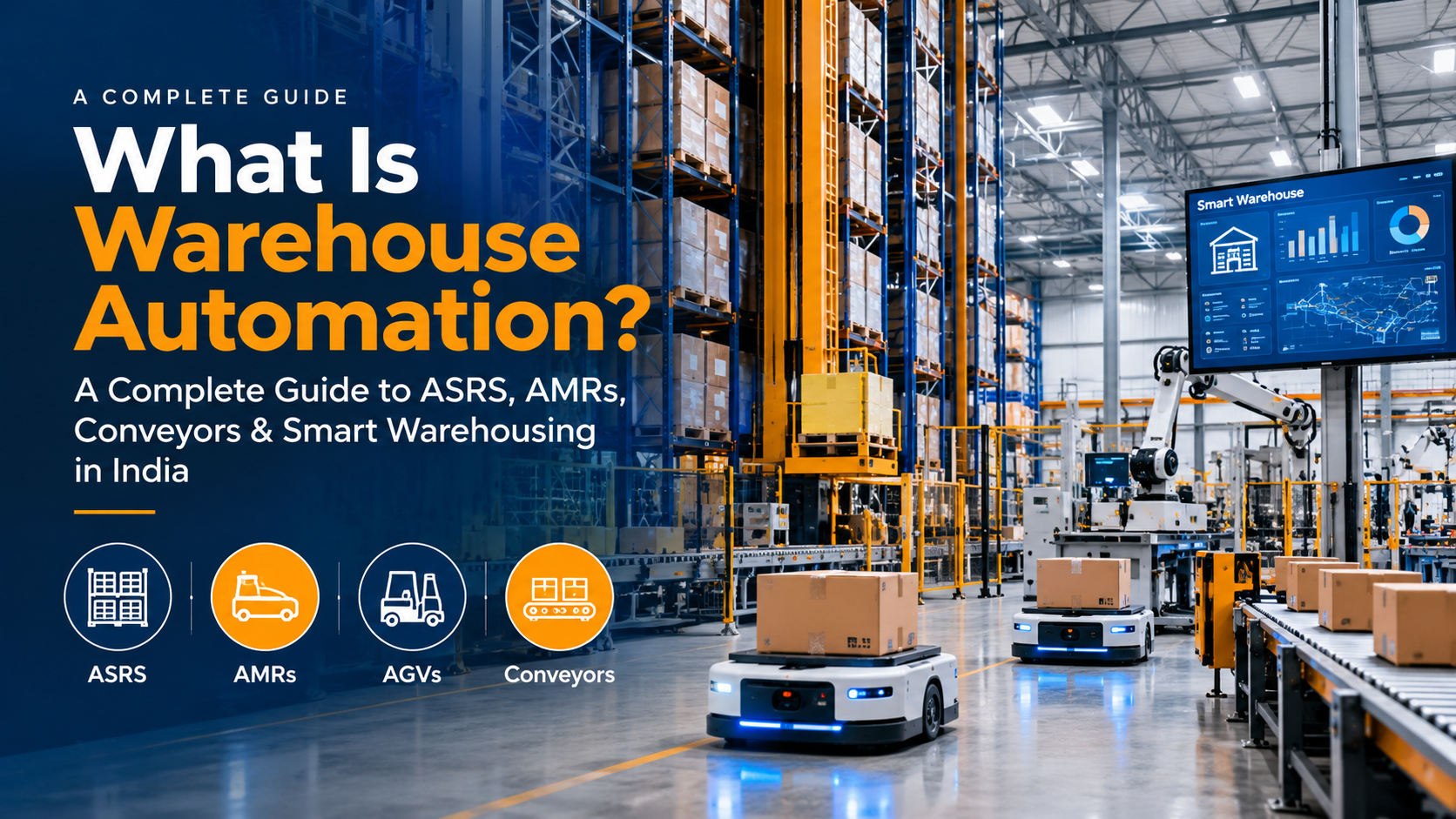
Warehouse automation uses equipment, robotics, software and control systems to automate the storage, movement, retrieval, sorting and handling of goods inside a warehouse or distribution facility.
Depending on the operation, warehouse automation may include Automated Storage and Retrieval Systems (ASRS), Autonomous Mobile Robots (AMRs), Automated Guided Vehicles (AGVs), conveyors, sortation systems, robotics and warehouse-control software.
The objective is not simply to replace manual activity.
A successful warehouse automation strategy should improve the overall flow of material while addressing business requirements such as throughput, storage density, accuracy, scalability, safety and operational reliability.
This is becoming increasingly relevant for warehouse automation in India as logistics, manufacturing and e-commerce companies move toward higher-quality, technology-enabled facilities. CBRE’s 2026 India logistics outlook notes a continued shift toward technology-driven warehousing and cites growth in the country’s warehouse automation market.
What Does Warehouse Automation Actually Automate?
Warehouse automation can address several different processes.
These may include receiving goods, pallet or carton movement, put-away, storage, replenishment, picking, order consolidation, sorting, packing and dispatch.
This is important because there is no single machine called a “warehouse automation system.”
A warehouse may require automation only for internal transport, while another facility may need high-density automated storage, goods-to-person picking, sortation and integrated software.
The right starting point is therefore the operational problem, not the technology.
What Is ASRS in Warehouse Automation?
ASRS stands for Automated Storage and Retrieval System. It automatically stores products in defined locations and retrieves them when required using computer-controlled equipment.
MHI describes ASRS as systems combining equipment and controls to automatically handle, store and retrieve materials with precision and speed. ASRS technologies can include unit-load systems, mini-load systems, vertical lift modules, shuttles and cube-based storage.
ASRS is particularly relevant when an operation needs to improve storage density or reduce manual travel associated with retrieving inventory.
Typical applications include:
- Pallet storage
- Tote and carton storage
- Goods-to-person picking
- Buffer storage
- Production supply
- Finished-goods warehouses
- High-density distribution centres
However, ASRS should not be selected only because it is highly automated. The business should first validate SKU characteristics, inventory profile, throughput, building height, floor conditions, fire and safety requirements, upstream and downstream flow, maintenance capability and future growth.
What Is an AMR?
An Autonomous Mobile Robot, or AMR, is a mobile robotic system that can move materials through a facility while dynamically navigating its environment.
Unlike systems that depend entirely on predefined physical routes, AMRs can use sensors, mapping and onboard computing to navigate between destinations.
MHI distinguishes AMRs from traditional AGVs primarily by this routing flexibility: AGVs generally operate along predetermined paths, whereas AMRs can dynamically navigate and reroute around obstacles.
AMRs may be used for:
- Tote transport
- Cart movement
- Goods-to-person operations
- Line-side delivery
- Picking assistance
- Workstation replenishment
- Movement between process areas
They can be particularly useful where workflows change frequently or where a facility wants to scale automation progressively.
What Is an AGV?
An Automated Guided Vehicle, or AGV, is a driverless material-handling vehicle designed to move loads along controlled or predefined routes.
AGVs have long been used in predictable industrial environments where material repeatedly moves between known points.
For example, they may transport pallets or components between a warehouse and production line.
An AGV can be a strong option when routes are stable and repeatable.
An AMR may be more appropriate where routing needs greater flexibility.
Neither technology is automatically better. The selection depends on the application.
What Do Conveyors Do in an Automated Warehouse?
Conveyors provide continuous movement of cartons, totes, pallets or other loads along defined routes within a facility.
MHI describes conveyors as material-handling devices used to move products and loads horizontally, vertically or on an incline through manufacturing and distribution operations.
Conveyors work particularly well when:
- Flow is predictable
- Material follows fixed routes
- High volumes repeatedly move between the same points
- Continuous transport is required
- Process stations can be linked together
Modern installations may combine conveyors with barcode readers, sensors, sorters, robotics, ASRS and warehouse-control software.
What Is a Smart Warehouse?
A smart warehouse connects automation equipment with software and real-time operational data.
The technology stack may include:
WMS — Warehouse Management System: manages inventory and warehouse processes.
WCS — Warehouse Control System: coordinates automated equipment and material flow.
WES — Warehouse Execution System: can orchestrate warehouse work and automation execution.
PLC and equipment controls: control individual machines and automation subsystems.
Sensors and identification systems: provide information about products, equipment and process status.
The precise architecture depends on the facility.
A sophisticated warehouse does not necessarily need every software layer. Integration should be designed around operational requirements.
What Are the Main Benefits of Warehouse Automation?
The value of automation should be measured against specific business outcomes.
Potential benefits include improved storage utilization, higher throughput, lower manual travel, more repeatable processes, better inventory handling, improved traceability and greater ability to scale operations.
ASRS can also support high-density storage by using vertical cube space more effectively.
However, automation does not automatically produce these benefits.
Poor process design can simply automate an inefficient process.
That is why process assessment should happen before equipment selection.
When Should a Company Consider Warehouse Automation?
Automation may be worth evaluating when a warehouse experiences sustained operational constraints such as increasing order volumes, limited storage space, excessive worker travel, repetitive material movement, difficulty maintaining throughput, high picking complexity or plans for significant future growth.
Another indicator is a facility that is being designed or expanded and needs to determine the right level of automation before CAPEX is committed.
Key Factors to Consider Before Implementing Warehouse Automation
1. Define the Business Problem Before Choosing Technology
Warehouse automation should begin with a clearly defined operational problem. Companies should first identify whether the primary issue is low storage capacity, excessive manual travel, slow order fulfilment, labour dependency, picking errors, congestion or inability to handle future growth.
Choosing ASRS, AMRs, AGVs or conveyors without understanding the actual problem can lead to unnecessary CAPEX and poor system utilisation. The objective should be to solve measurable operational constraints rather than simply introduce advanced technology.
2. Analyse Current and Future Throughput
Throughput is one of the most important inputs in automation design.
Businesses should measure pallets, cartons, totes or order lines handled per hour and per day. Both average and peak throughput should be considered because automation designed only around average demand may struggle during seasonal or promotional peaks.
Future business growth should also be factored into system sizing. A warehouse automation solution should ideally support planned expansion without requiring a complete redesign.
3. Conduct Detailed SKU Profiling
Not all SKUs behave in the same way.
Warehouse planners should analyse SKU velocity, dimensions, weight, storage duration, order frequency and handling characteristics. Fast-moving items may require quick-access storage, while slow-moving products can be placed in denser storage zones.
ABC classification can also help determine which inventory should be positioned closest to picking or dispatch areas.
Accurate SKU profiling is especially important when evaluating ASRS and goods-to-person systems.
4. Map End-to-End Material Flow
Automation should be designed around the complete movement of materials.
This includes:
Receiving → Quality Check → Put-away → Storage → Replenishment → Picking → Packing → Sorting → Dispatch.
Material-flow mapping helps identify bottlenecks, unnecessary travel and duplicate handling.
A common mistake is to automate one individual process without understanding how it affects upstream and downstream operations. Improving one area can simply move the bottleneck somewhere else.
5. Evaluate Greenfield and Brownfield Constraints
Automation design is very different for a new facility compared with an existing warehouse.
A greenfield project allows more freedom in terms of layout, clear height, racking, floor design, utilities and automation infrastructure.
Brownfield projects must work around existing building conditions, operating processes, structural columns, fire systems, electrical capacity and ongoing warehouse activity.
For existing warehouses, implementation planning should also consider how automation can be installed without significantly disrupting day-to-day operations.
6. Assess System Availability and Redundancy
A fast automation system is not useful if one equipment failure stops the entire warehouse.
Engineering teams should analyse possible single points of failure and define appropriate redundancy.
Important questions include:
- What happens if one ASRS crane stops?
- Can another route handle the material?
- What happens if a conveyor zone fails?
- Can AMRs operate if part of the network is unavailable?
- How quickly can critical equipment be restored?
System availability should therefore be considered alongside throughput.
7. Plan Software Integration Early
Modern warehouse automation depends heavily on software integration.
Automation equipment may need to communicate with ERP, WMS, WCS, WES, PLCs, scanners, sensors and third-party platforms.
Interface responsibilities should be clearly defined before project execution begins.
Poorly defined software interfaces can result in delays during commissioning even when the physical equipment is completely installed.
The project should clearly define who owns each integration, what data is exchanged and what happens when communication fails.
8. Consider Total Cost of Ownership
Initial equipment cost should not be the only factor in warehouse automation selection.
Companies should evaluate the complete lifecycle cost, including:
- Maintenance
- Spare parts
- Software licences
- Energy consumption
- Vendor support
- AMC costs
- Operator training
- System upgrades
- Replacement components
- Downtime risk
A system with a lower initial CAPEX may become more expensive over its operating life if maintenance and support costs are high.
9. Define FAT, SAT and Performance Acceptance Criteria
Testing requirements should be established before issuing purchase orders.
Factory Acceptance Testing (FAT) can verify equipment functionality before dispatch, while Site Acceptance Testing (SAT) confirms performance after installation and integration.
Acceptance criteria should be measurable.
Typical parameters may include throughput, accuracy, alarms, safety functions, software interfaces, recovery procedures and system availability.
Clear acceptance criteria help reduce disputes between project owners and suppliers.
10. Plan for Operations, Maintenance and Future Expansion
Warehouse automation should be designed for long-term operation, not just successful commissioning.
Maintenance teams need access to equipment, diagnostic tools, critical spare parts and appropriate technical training.
The system should also allow future expansion wherever practical.
Businesses should ask whether additional storage, robots, conveyor zones or workstations can be added later without major redesign.
A scalable automation architecture can protect the investment as the organization grows.
Expert Takeaway
The most successful warehouse automation projects are not necessarily the ones with the highest level of technology. They are the ones where business requirements, material flow, engineering design, software integration, maintainability and future growth are aligned from the beginning.
For project owners, independent engineering review can help validate whether the proposed automation concept is technically suitable, scalable and commercially justified before significant investment is committed.
The key question should not be:
“Which robot should we buy?”
It should be:
“What operational problem are we trying to solve, and what technology provides the best lifecycle solution?”
MHI similarly recommends understanding existing processes, material flows and long-term objectives before selecting automation technology.
Does Every Warehouse Need Full Automation?
No.
A partially automated warehouse may provide a stronger business case than a fully automated facility.
For example, an organization may retain manual picking but automate long-distance tote transport with AMRs.
Another facility may automate pallet storage using ASRS while retaining conventional outbound processes.
A third operation may only require conveyors and sortation.
Automation should therefore be right-sized.
How Should Warehouse Automation Be Selected?
A structured technology evaluation should consider:
- Current and forecast throughput
- SKU count and SKU characteristics
- Inventory levels and storage density
- Pallet, tote and carton dimensions
- Order profile
- Picking strategy
- Building geometry
- Floor and infrastructure conditions
- Required availability and redundancy
- Peak-volume requirements
- Software integration
- Safety
- Maintenance capability
- Scalability
- CAPEX and lifecycle cost
These inputs should be converted into clear functional requirements before vendors are invited to propose equipment.
How to Define Warehouse Automation Requirements Before Selecting Technology
Before selecting ASRS, AMRs, AGVs, conveyors or any other warehouse automation technology, companies should first define their operational requirements in measurable terms. Technology selection should begin with data, not with a preferred machine or vendor. Important inputs include current and forecast throughput, number of SKUs, inventory levels, pallet and carton dimensions, order-line profile, picking frequency, peak-season demand, storage density, shift patterns and expected business growth.
The company should also map the complete material flow from receiving and put-away to storage, replenishment, picking, packing and dispatch. This helps identify where delays, excessive travel, congestion or manual handling are actually occurring. Future requirements are equally important because an automation system designed only for today’s volumes may become a bottleneck as the business expands.
Engineering teams should also define required system availability, redundancy, maintenance access, software integration, safety requirements and acceptable recovery time following equipment failure. These requirements can then be converted into a structured User Requirement Specification (URS) for vendor evaluation.
A well-defined requirement document enables suppliers to propose solutions against the same operational criteria, making technical comparison more objective. For project owners, this reduces the risk of selecting an impressive automation technology that does not solve the warehouse’s actual business and operational needs.
What Is the Role of Independent Warehouse Automation Advisory?
Automation suppliers naturally understand their own technologies well.
But project owners often need a broader, vendor-neutral perspective before committing to a solution.
Independent engineering advisory can help organizations define requirements, evaluate technologies, review layouts, compare vendor proposals, identify technical risks and validate whether a proposed system aligns with actual operating needs.
NexPari’s Engineering Advisory scope specifically includes Technology Evaluation, Vendor Selection Support, Technical Due Diligence and Automation Strategy, making this type of warehouse decision directly aligned with its stated service offering.
Warehouse Automation in India: Where Is the Market Moving?
India’s industrial and logistics market continues to see demand from 3PL, engineering and manufacturing, and e-commerce occupiers. In H1 2026, CBRE reported that 3PL and engineering/manufacturing together represented significant shares of warehousing absorption.
This does not mean every new Indian warehouse should become fully automated.
It means warehouse operators increasingly need to evaluate automation as part of facility strategy, particularly where scale, throughput, storage density and service-level expectations justify it.
How NexPari Supports Warehouse Automation Projects
NexPari supports industrial and warehouse projects through independent engineering advisory.
Its website identifies manufacturers, warehouses and logistics organizations as target clients for technology evaluation, automation strategy, vendor selection and execution advisory.
Support can extend across the project lifecycle—from defining requirements and reviewing automation technologies to vendor evaluation, technical assurance, FAT/SAT coordination and commissioning oversight. NexPari’s Owner’s Engineering and Technical Assurance services also cover vendor review, acceptance testing and commissioning-related activities.
Planning Warehouse Automation in India?
Selecting an automation system is a long-term engineering and operational decision.
Talk to NexPari for vendor-neutral warehouse automation and engineering advisory support—from technology evaluation and vendor review to technical assurance and project execution.
CTA: Discuss Your Warehouse Automation Project
FAQs
What is warehouse automation?
Warehouse automation is the use of equipment, robotics, control systems and software to automate storage, retrieval, transportation, sorting and other warehouse processes.
What is ASRS?
ASRS is an Automated Storage and Retrieval System that automatically stores and retrieves inventory from defined storage locations.
What is the difference between AMR and AGV?
AGVs generally operate along predetermined paths, while AMRs use onboard navigation to move more flexibly and reroute when required.
Are conveyors still useful in modern smart warehouses?
Yes. Conveyors remain effective for high-volume, repeatable material flows along fixed routes and are often integrated with ASRS, sorters and robotics.
Which warehouse automation system is best?
There is no universally best system. The appropriate solution depends on throughput, SKU profile, storage requirements, facility layout, workflow variability, scalability and investment objectives.
Does NexPari provide warehouse automation consulting?
NexPari’s Engineering Advisory services include technology evaluation, automation strategy, vendor selection support and execution advisory for manufacturers, warehouses and logistics organizations.